General information regarding the SILDIS calculation software for acoustics and aeraulics in the construction sector (Excel-based CAD tool)
The consideration of acoustics and aeraulics in a construction project is necessary in relation to different works trades: architectural, technical, not to mention the envelope.
With regard to related issues, SILDIS software makes it possible to easily, quickly, and reliably perform Computer Aided Design tasks.
All calculations are possible taking into account contextualized thermodynamic conditions:
- for ambient air (e.g. for ordinary applications in the building sector with the exception of those related to exhaust gases, involving high temperatures, for which calculations are also possible)
- as required for simulations in the context of industrial construction projects (possibly with fluids other than air and with extreme temperature and pressure conditions)
In terms of acoustics, the frequency range considered for single frequency simulations is 20 Hz - 20 kHz, the performance indicators being provided in bands of 1/3 octave, 1/1 octave and in the form of a unique index with respect to a reference sound spectrum (e.g. αw, Rw).
The fact that the SILDIS acoustic calculation software is in Excel format, with drop-down menus and with the possibility of selecting materials from libraries [1] makes it a practical tool for various participants in the construction process: project managers, architects, consultants, technicians and engineers from design offices (acousticians, specialists in aeraulics and fluids) and manufacturers Research and Development (R&D) centers. SILDIS can be used, depending on the context, in the field of construction as in the industrial sector:
- to carry out calculations as part of engineering missions, allowing modeling in terms of predictive acoustics and sizing of soundproofing equipment
- to prepare and optimize laboratory measurement campaigns, by pre-selecting configurations worthy of interest as part of the development of acoustic insulation or rooms reverberation control products and systems, or of silencers (SILDIS® offers a virtual acoustics laboratory environment)
This article outlines the main application areas of the software, of which development and validation is regularly certified as compliant with the ISO 9001 Quality Management standard since 2015.
Main calculations with SILDIS software for acoustics and aeraulics in the construction sector (Excel-based CAD tool)
The SILDIS acoustic calculation software can be used for engineering assignments (whether of standard or exceptional technical complexity) as well as Research and development (R&D) contexts. It serves for modeling sound and noise propagation, absorption, and attenuation in the construction sector (buildings and industry); regarding silencers, it also enables the prediction of aerodynamic performance. More precisely, the main applications are as follows:
- limitation of noise transmission in ducts
- sound transmission through partitions
- sound absorption
- sound propagation inside rooms
- sound transmission outside of buildings
- sound propagation outdoor
- pressurized fluids networks noise
They are detailed below.
Limitation of noise transmission in ducts
The SILDIS acoustic calculation software allows the prediction of the insertion loss, of the self noise and of the total pressure loss of elements of aeraulic networks whose impact, in the event of accumulation, is calculated:
- silencers [6], either reactive - i.e. of which efficiency is based on sound reflections due to geometry changes inside expansion chamber -, resonant or dissipative - i.e. with sound absorbing lining, possibly multilayered - (also possibly hybrid). The calculations are possible by combining plates (e.g. steel, aluminum) [4] possibly perforated, porous materials (glass wool, rock wool, basalt wool, polyester or based on ceramic fibers wools, foams) [3] and facings (cloths, fabrics) [5]
- straight lengths (including industrial stacks-chimneys), elbows, nozzles
The components of the air network can be of rectangular, square or circular cross section.
The software's potential applications extend beyond Heating Ventilation Air Conditioning (HVAC) systems to include the design and sizing of industrial air-handling networks - including those handling flue gases or ultra-high-temperature flows e.g. engine or combustion turbine exhausts - wherever noise limitation or acoustic comfort is a key consideration.
Regarding silencers in particular, the SILDIS software stands out - compared to other calculation methods used elsewhere to design aircraft, rockets, and submarines - due to its operational characteristics:
- no need to create or import geometry, and no need for meshing (the geometries are pre-programmed and configurable)
- no need for massive computing power or waiting hours for simulation results (display is virtually instantaneous)
- more generally: no need for highly specialized personnel to perform the calculations (training and achieving operational autonomy takes only a few hours)
Specifically regarding reactive silencers (depending on the software version in question):
- without perforated tubes, 1 to 3 expansion chambers can be considered for calculations, with axial or radial inlets and outlets (12 combinations), and flow-reversal combinations are possible (including configurations with overlapping inlet and outlet tubes)
- with perforated tubes, 1 or 2 sub-chambers (plug-silencer) are possible
- with branch resonators, various configurations are possible
Specifically regarding dissipative silencers (depending on the software version):
- the cross-section may be rectangular, square, or circular (matching that of other components in the air distribution system); for circular silencers, this includes options with or without a central splitter, and potentially with sound-absorbing lining in the form of concentric rings
- the sound-absorbing lining may be unique aka uniform (shared by all lining elements i.e. symmetrical where applicable) or not (then: unsymmetrical), and may incorporate some or all of the characteristics of the acoustic structures detailed below for acoustic absorption (thereby being subject to any associated modeling)
Undoubtedly, calculations relating to these noise-reduction devices are the most demanding in terms of modeling, requiring a multidisciplinary scientific background and extensive mathematical computation ((utilizing numerical techniques that rely heavily on iteration). The final word has not yet been said and even less written regarding the acoustic performance of silencers for industrial applications; thanks to its versatility (accommodating diverse geometries and physical effects) and its power (featuring state-of-the-art models for every simulation stage and uncompromising functional validation), the SILDIS software represents the pinnacle for sizing silencers based on established principles, while further expanding the realm of possibilities for eventual breakthrough technologies.
For a silencer, the results of the calculations are comparable with the standardized measurement: see NF EN ISO 7235 Acoustics - Laboratory measurement procedures for silencers in ducts and terminal units - Insertion loss, flow noise and total pressure loss.
Thanks to the SILDIS software, such laboratory tests can be prepared by selecting configurations - then: in an optimized number - that are expected in view of the results of simulations conducted before anything else - to yield an official confirmation of the silencer's acoustic and aerodynamic performance through laboratory measurements. While standard laboratory tests (almost always?) account only for clean, dry air at ambient temperature, and when the prediction need relates to (very) high operating temperatures (rendering their results unusable - and non-extrapolatable to anyone familiar with the underlying physics -), SILDIS software enables performance evaluation regarding noise reduction and pressure drop just as easily as for ambient-air simulations, while effectively accounting for the influence of temperature at every required stage of the calculations.
|
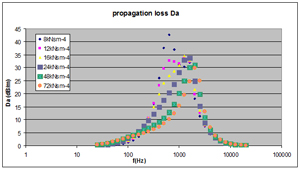
Figure 1 example of the dependence of the acoustic performance of a dissipative silencer on the airflow resistance of its lining, in terms of longitudinal attenuation aka propagation loss (dB/m), as can be evaluated with the SILDIS software |
Cf. Module(s) 1, 1+, 1A, 1B, 3, 4, 5, 5A, 7, 8
>> Sound absorption/attenuation - Modeling of hybrid resonators with CAD software SILDIS
>> Acoustics - Boosting silencer performance
>> Design and calculations of high performance baffle (splitter) silencers
>> Noise attenuation - Cylindrical dissipative silencer with reduced pressure drop
>> Modeling of the propagation and attenuation of noise in aeraulic networks with SILDIS software
>> Acoustics - simulation software SILDIS – silencers sizing online
>> Silencers - Modeling the acoustic behavior of curved absorbers
>> Sizing of reactive silencers with non-perforated tubes with the simulation software SILDIS
Sound transmission through partitions
The SILDIS acoustic calculation software allows the prediction of the sound reduction index of walls, possibly multilayered, for sound insulation:
- constituting the envelope of buildings: walls, slabs, roofs or subject to interior carpentry work (e.g. metal or wood joinery) and plastering: partitions, ceilings, linings, not to mention industrial acoustic insulation panels, screens (noise barriers) and also components of glass doors and frames
- constituting the envelope of ducts or of silencers inserted in ventilation and air conditioning networks or in chimneys
Calculations are possible by combining plates (e.g. concrete, plaster, wood, steel, aluminum, glass) [2], possibly joined together, and porous materials (glass wool, rock wool, basalt wool polyester or ceramic fiber based wool, foams) [3].
The plates can be plane, orthotropic (i.e. with corrugations), perforated, with or without a bonded viscoelastic damping layer (e.g. septum, PVB): extensional or constrained (between 2 plates: sandwich panels).
This allows for the modeling of both simple walls (e.g. a single layer of mineral wool or foam) and much more complex ones (featuring alternating layers of varying-thickness panels and different types of wool - air is possible too -), the acoustic structure used for calculations possibly comprising between one and four assemblies, each (potentially) consisting of a porous medium, with or without a series facing, a perforated protective layer, and/or panels of varying thickness; if necessary, an additional set - consisting of a single thin panel - can be included at the rear of this material stack. Depending on the context, the acoustic structure used for modeling may consist of 1 to 17 layers; iIt is also possible to account - in a simplified manner - for a thermal gradient, namely in case of flat-walled ducts conveying ultra-high-temperature gas (e.g. for exhaust systems), where thick, low-thermal-conductivity materials may create temperature non-uniformity which alters the acoustic behavior of the porous material layers depending on their specific position within the wall thickness.
The results of the calculations are comparable to the standard measurement: cf. NF EN ISO 140-3 Acoustics - Measurement of sound insulation in buildings and of building elements - Part 3: laboratory measurement of airborne sound insulation of building elements.
The points raised earlier regarding the limitation of noise transmission in ducts also apply to sound transmission through partitions, specifically concerning the utility of the SILDIS software:
- for the efficient preparation of laboratory tests (while also minimizing time and costs)
- for filling the significant gap - found in many industrial contexts - left by the absence of standardized laboratory measurement protocols for flat partitions where the sound reduction index at high temperatures needs to be determined e.g. for rectangular flue gas exhaust ducts (no recognized official test facility exists to quantify this performance indicator, nor is there any known measurement standard covering this specific issue)
|
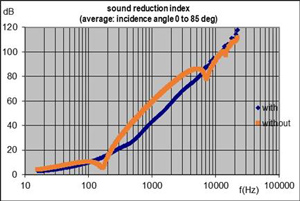
Figure 2 sound reduction index of a double wall, consisting of a steel plate (1 mm thick) and an aluminum plate (2 mm thick), with - this is then called corrugated sheet - or without corrugations, separated by a porous medium (e.g. wool, mineral or other) with a resistivity of 12.5 kNsm-4, porosity 0.95. For the frequency of 500 Hz, the sound reduction index reaches 27.5 dB with the corrugations, against 43.0 dB without the corrugations, what illustrates (if the frequency of 500 Hz is what one is focusing on), a considerable variation in performance. |
Cf. Module(s) 2 / 2+
Sound absorption
The SILDIS acoustic calculation software allows the prediction of the sound absorption coefficient of linings, possibly multilayered, for the limitation of the reverberation of premises:
- constituting ceiling tiles and suspended baffles, wall panels, laggings, not to mention industrial sound insulation panels, screens (noise barriers) and dividers
Calculations are possible by combining plates (e.g. plaster, wood, steel, aluminum)[4] possibly perforated, porous materials (glass wool, rock wool, basalt wool, polyester ceramic fibers based wool, foams) [3] and facings (cloths, fabrics) [5].
The points made earlier regarding sound transmission through partitions also apply to sound absorption in terms of the utility of the SILDIS software, with one exception: thin sheets are not explicitly included in the calculation (though some versions of the software allow series facings to be modeled as elastic sheets, which yields the same result).
It is thus possible to model both simple partitions (e.g. a single layer of mineral wool or foam) and much more complex ones (featuring alternating layers of different materials, including air). The acoustic structure underlying the calculations can comprise between one and four assemblies, each potentially consisting of a porous medium, with or without a series facing, and with or without a perforated protective layer. Depending on the specific case, the acoustic structure used for modeling can therefore range from 1 to 12 layers.
The results of the calculations are comparable to the standard measurement: cf. NF EN ISO 354 Acoustics - Measurement of sound absorption in a reverberation room and also standard ISO 10534-1 Acoustics - Determination of the sound absorption coefficient and impedance in impedance tubes - Part 1: Method using standing wave ratio.
The points raised earlier regarding the limitation of noise transmission in ducts, and sound transmission through partitions also apply to sound absorption in terms of the utility of the SILDIS software:
- streamlining the preparation and conduct of laboratory tests (specifically regarding the resources required for samples and models preparation, the use of test rigs, and the long-term allocation of personnel)
- overcoming the impossibility of basing the evaluation of acoustic absorption for a material or, more generally, an acoustic structure (e.g. multilayer) on laboratory measurements for high-temperature applications (common in the industrial sector), given the absence of both measurement protocols or test rigs (that should be standardized) in this field
Better yet?
Whether based on the use of a standing-wave tube (also known as a Kundt's tube) or a reverberation room, measurements of the sound absorption coefficient of materials or, more generally, of an acoustic structure (e.g. a multilayer one) always consider (in practice) an impervious rigid back (such as the end of the Kundt's tube or the floor of the reverberation room). This might inspire circumspection to anyone realizing that when a sound-absorbing material like mineral wool or polyester wool is incorporated into a soundproofing panel (such as those commonly used for machine enclosures or noise barriers), this assumption holds true (in practice) only if one accepts that a metal sheet as thin as one millimeter (or even a fraction of a millimeter for panels sold by suppliers targeting less quality- and durability-conscious customers) which, together with the mineral wool, forms the panel's entire acoustic structure is - itself, and nothing else instead because there is only air apart from them - the impervious rigid back implicitly assumed when laboratory measurement results for the sound absorption coefficient are used in calculation notes.
This is - to say the least -debatable (depending on the frequency). In any case, SILDIS saves the time of such a discussion and allows this specific case to be easily accounted for when modeling the acoustic absorption of multilayer structures as a single mouse click is all that is needed to select a "rear atmosphere" condition (with configurable climatic parameters) for the back of the acoustic structure, instead of an "impervious rigid back".
What else?
The calculation routines implemented in certain versions of the software account for phenomena requiring a higher level of sophistication in modeling the acoustic behavior of multilayer acoustic structures - sometimes utilizing theories and measurement results derived from the latest Research and Development (R&D) work-:
- modeling of perforated plates as porous media, accounting for interactions (at the perforations) with adjacent porous media
- inclusion of resonators (e.g. of Helmholtz type) and, more generally of cavities i.e. cells characterized, relative to the surface perpendicular to their thickness axis - i.e. with respect to the plane of the layers, one can in the transverse direction - by a specific geometric shape and finite dimensions; this distinction from the - ordinary - case of considering layers of infinite dimensions (transversally, in the sense just indicated, whereas the thickness itself remains finite) is useful for resonator design, possibly involving the presence - within each of the aforementioned cells (forming a compartmentalized structure that resembles a honeycomb when hexagonal) - of elastic plates (membranes), the dimensions of which are fundamental for sound absorption across a frequency band of varying width, featuring one or more resonance peaks of varying height
- consideration of the acoustic structure's excitation level: its performance - in terms of the sound absorption coefficient -is no longer viewed as an intrinsic property (as in the linear acoustics hypothesis) but rather as a variable dependent on the acoustic intensity level (the realm of non-linear acoustics, a field still largely unexplored)
The aim of creating a simulation tool useful for both engineering projects and Research and Development (R&D) tasks makes particular sense in this context: the calculations currently performed using the SILDIS software could well underpin the innovations of tomorrow.
|
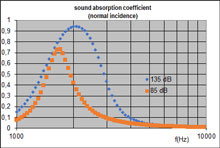
Figure 3 illustration of non-linearity of the response of a micro-perforated plate to sound excitation: acoustic absorption coefficient under normal incidence (with a ratio circular perforations diameter to thickness being 1, a porosity being 2 %, a cavity depth 0.01 m, a scanning sinusoidal source with a level of 85 dB or 135 dB (accoutning reflections on the sound absorbing lining) |
Cf. Module(s) 2 / 2+
>> Sound absorption/attenuation - Modeling of hybrid resonators with CAD software SILDIS
Sound propagation inside rooms
The SILDIS acoustic calculation software allows the prediction of the reverberation time and the sound spatial decay in rooms, for acoustic comfort and noise limitation.
The results of the calculations are comparable with standardized measurement: NF EN ISO 3382-2 Acoustics -Measurement of room acoustics parameters- Part 2: reverberation time in ordinary rooms and NF EN ISO 3382-3 Acoustics -Measurement of room acoustics parameters- Part 3: Open plan offices.
Cf. Module(s) 9, 9A
>> Integration of the prediction of sound decay in enclosed spaces to the simulation software SILDIS
Sound transmission outside of buildings
The SILDIS acoustic calculation software enables - whether considering an entire façade (wall or roof) or merely a subset of its constituent elements, whatever they are e.g. when analyzing sound wave paths is a modeling objective - the prediction of sound power and sound pressure levels at specified locations, including - and especially - at short distances, where the assumptions underlying ultra-simplified formulas do not hold true, what could yield - in case of inappropriate use of such approaches - to calculation results insufficiently accurate for assessing an installation's compliance regarding contractual, regulatory, and human considerations (such as the risk of hearing damage for industrial site workers or noise disturbance for neighbors).
Some of the results of calculations with SILDIS acoustics simulation software are comparable with results of calculations based on standard ISO ISO 12354-4 Building acoustics - Estimation of acoustic performance of buildings from the performance of elements - Part 4: Transmission of indoor sound to the outside.
|
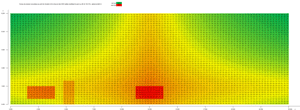
Figure 4 simulation using Module 10 of the SILDIS software for predicting sound emissions from buildings and other constructions, of the sound pressure level at a specified location (in the middle of the length of one of the longitudinal facades of a ventilated sound enclosure, with a length 25.0 m, with a height 8.2 m, at 1.5 m from the ground) due to each of the 5000 cells (in this case, with a unit area of 0.04 m2) modeling the wall (dB ref 2E-5Pa - overall A-weighted); the impact of a door (vertical rectangle) and of 2 ventilation silencers (horizontal rectangles) is clearly observable in the lower part of the building wall. |
Cf. Module(s) 10
Sound propagation outdoor
The SILDIS acoustic calculation software allows the prediction of stacks directivity, of atmospheric sound absorption.
Some of the calculation results are comparable with some input data envisaged in standardized calculation: cf. NF EN ISO 9613-2 Acoustics -- Attenuation of sound during propagation outdoors -- Part 2: General method of calculation.
Cf. Module(s) 8A, 8B
Overall, regarding SILDIS calculation software for acoustics and aeraulics in the construction sector (Excel-based CAD tool)
SILDIS® calculation software for acoustics and aeraulics in the construction sector (in Excel format) is a versatile tool for Computer Aided Design (CAD): marketed (with associated training) by Isolation Technologie Services (ITS) in the form of modules, some of which are grouped in packs, according to the needs of users (interface available in French or in English)
- Prediction of the acoustic and aerodynamic performance of dissipative or resonant silencers (Module 1), as well as silencers with discontinuous splitters (Module 1A) and reactive silencers (Module 1B)
- Prediction of the acoustic performance of flat surfaces (Module 2)
- Prediction of the acoustic performance of duct walls (Module 3)
- Prediction of the acoustic performance of straight ducts in air distribution systems (Module 4)
- Prediction of casing noise: either of straight ducts in air distribution systems, or of silencers (Module 5), or of ducts with variable cross-section (Module 5A)
- Prediction of the acoustic performance of bends and junctions in air distribution systems (Module 6)
- Prediction of nozzle reflection (Module 7)
- Prediction of the sound impact of air distribution systems (Module 8)
- Prediction of the directivity of industrial chimneys (Module 8A)
- Prediction of sound absorption by the atmosphere (Module 8B)
- Prediction of the aerodynamic noise of control valves (Module 8C)
- Prediction of jet noise, including safety valve noise (Module 8D)
- Prediction of discharge factors for fluid networks (Module 8E)
- Determination of the performance and sizing of safety valves (Module 8F)
- Simulation of fluid discharge through piping downstream of a valve (Module 8G)
- Prediction of the acoustic and aerodynamic performance of pressurized gas expansion silencers (Module 8H)
- Prediction of sound decay in enclosed spaces (Module 9)
- Prediction of spatial sound decay in open-plan offices (Module 9A)
- Prediction of noise emissions from buildings and other structures (Module 10)
- Calculation of required parameters – as input data – for calculating the acoustic and aerodynamic performance of mesh-based silencers (Module 11)
The software output data, in terms of simulation of the sound transmission through walls, of sound absorption, of the limitation of noise transmission in ducts, of sound propagation inside rooms and outdoor are useful for many projects, allowing sizing and technical optimization of various construction products and systems, in relation to issues being acoustic comfort and / or soundproofing.
The SILDIS acoustic calculation software is useful for modeling the propagation, absorption, and attenuation of sound and noise in the construction sector (buildings and industry); regarding silencers, it also enables the prediction of aerodynamic performance.
Overview of the main applications of SILDIS software for acoustics and aeraulics in the construction sector, and associated modules
| Application / Module | 1 | 1+ | 1A | 1B | 2 | 2+ | 3 | 4 | 5 | 5A | 6 | 7 | 8 | 8A | 8B | 8C | 8D | 8E | 8F | 8G | 8H | 9 | 9A | 10 |
| Limitation of noise transmission in ducts | x | x | x | x | x | x | x | x | x | x | x | |||||||||||||
| Sound transmission through partitions | x | x | ||||||||||||||||||||||
| Sound absorption | x | x | ||||||||||||||||||||||
| Sound propagation inside rooms | x | x | ||||||||||||||||||||||
| Sound transmission outside of buildings | x | |||||||||||||||||||||||
| Sound propagation outdoor | x | x | ||||||||||||||||||||||
| Pressurized fluids networks noise | x | x | x | x | x | x | ||||||||||||||||||
L
SILDIS® software Module(s)>> Acoustics simulation software SILDIS
>> SILDIS software Modules 2 / 2+ Prediction of acoustic performance of plane partitions and walls
>> Design and calculations of high performance baffle (splitter) silencers
>> Noise attenuation - Cylindrical dissipative silencer with reduced pressure drop
>> Modeling of the propagation and attenuation of noise in aeraulic networks with SILDIS software
>> Acoustics - simulation software SILDIS – silencers sizing online
>> Silencers - Modeling the acoustic behavior of curved absorbers
>> Room acoustics simulation by ray tracing with ITS
>> Sizing of reactive silencers with non-perforated tubes with the simulation software SILDIS
>> Integration of the prediction of sound decay in enclosed spaces to the simulation software SILDIS
[1] the specific characteristics of the materials to be taken into account for the calculations - in addition to the thickness and number of layers, as well as their stacking order - are tabulated
[2] the specific characteristics taken into account are the Young's Modulus, the density, the Poisson factor, the loss coefficient
[3] the specific characteristics taken into account are the resistivity, the porosity, the tortuosity, the thermal characteristic length, the viscous characteristic length, the density
[4] the specific characteristics taken into account are the Young's Modulus, the density, the Poisson factor, the loss coefficient, and for some versions of the software the installation conditions (free or embedded) and the dimensions, and, in the case of perforated plates: the porosity, the geometry of the perforations
[5] the specific characteristics taken into account are the resistance to air flow, the surface mass
[6] the specific characteristics taken into account are the flow rate, the dimensional parameters (e.g. geometry of the internal parts, length)