The SILDIS®[0][1] software (in Excel format) enables the modeling of sound absorption of soundproofing materials, as illustrated by an example (numbered 2.4.0.0 in the user manual), which is the simplest possible case, involving a single layer (of foam), whereas Module 2 of the software allows for calculations regarding heterogeneous, multi-layer structures, with the possibility to combine:
- porous media (up to 4), e.g. mineral wools or others (e.g. glass- or metal-based), foams
- facings (up to 4): e.g. glass veils, needle mats, fabrics; in certain versions of the software, they can be assigned the properties of thin elastic plates
- perforated plates i.e. perforated protective layers (up to 4), e.g. plates with holes
Problem statement for modeling the sound absorption of a soundproofing material using SILDIS® software (example)
The objective is to model the sound absorption of an acoustic structure consisting of - all in all - a single layer [1] of melamine foam [2] - using the JKD general porous medium model [3] with a thickness of 0.1 m [4] assuming air at 20°C [5] and a pressure of 101325 Pa [6], with an impervious rigid back [7] such as the end of a Kundt's tube. The language used is English [8].
Involved calculations are of practical interest, potentially within the scope of engineering or Research and Development (R&D) projects, for the design of various soundproofing systems (eventually with other materials):
- controlling room reverberation using sound-absorbing coverings on walls or suspended from ceilings or roofs
- limiting sound transmission using acoustic insulation panels (e.g. walls and roofs for machinery and equipment noise-reducing enclosures)
- filling dissipative silencers
Input data to be entered for modeling the sound absorption of a soundproofing material using SILDIS® software (example)
Regarding the input data to be entered into the "in-COALA" Excel sheet of SILDIS® Module 2, for modeling the sound absorption of the soundproofing material taken as example, a distinction can be made - regarding the required data - based on the Excel sheet where the user wishes to view the results:
- if the "in-out COPPA" Excel worksheet is used, the displayed results reflect all selections made in the "in COALA" worksheet
- if the "in-out COPPA0" Excel worksheet is used, the displayed results are valid (regardless of selections made in the "in COALA" worksheet) based on the assumption of an impervious rigid back and excluding thin plates ("0 thin plates"); this reduces the input data table by two rows (shown in italics in the first table and removed in the second)
The input data required for the calculation are listed below, referencing the information provided above (see the bracketed numbers in the previous section, used as markers to explain the selection below). Input cells are identified by their Excel coordinates (column/row) in the following excerpt from the user manual.
Input data to be entered in the "in COALA" Excel worksheet for visualizing results in the "in-out COPPA" Excel worksheet
| Item | Cell for input | Foreseen action | Input | Landmark / comment |
| Language | AF2 | For English, select E,; for French, select F | E | [8] |
| Temperature (°C) | D5 | Enter a real number | 20 | [5] |
| Pressure (Pa) | D6 | Enter a positive real number | 101325 | [6] |
| Rear atmosphere ? (0/1) | O7 | For "yes", enter 1; for "no", enter 0 | 0 | [7] |
| Maximum set index imax | D19 | Entrer un nombre réel positif | 1 | [1] |
| Reference | J21 | Select a model (in a drop-down menu) | MELAMINE | [2] |
| General model for porous medium | J27 | Select a model (in a drop-down menu) | JKD | [3] |
| Thickness (m) | J56 | Enter a positive real number | 0.1 | [4] |
| Incorporation of the series cloths | AB26 | For "yes", enter 1; for "no", enter 0 | 0 | [1] |
| Incorporation of the series perforated protections | J125 | For "yes", enter 1; for "no", enter 0 | 0 | [1] |
| Number of identical plates | AB68, AC68 | Entrer un nombre réel positif | 0 | [1] |
Input data to be entered in the "in COALA" Excel worksheet for visualizing results in the "in-out COPPA0" Excel worksheet
| Item | Cell for input | Foreseen action | Input | Landmark / comment |
| Language | AF2 | For English, select E,; for French, select F | F | [8] |
| Temperature (°C) | D5 | Enter a real number | 20 | [5] |
| Pressure (Pa) | D6 | Enter a positive real number | 101325 | [6] |
| Maximum set index imax | D19 | Entrer un nombre réel positif | 1 | [1] |
| Reference | J21 | Select a model (in a drop-down menu) | MELAMINE | [2] |
| General model for porous medium | J27 | Select a model (in a drop-down menu) | JKD | [3] |
| Thickness (m) | J56 | Enter a positive real number | 0.1 | [4] |
| Incorporation of the series cloths | AB26 | For "yes", enter 1; for "no", enter 0 | 0 | [1] |
| Incorporation of the series perforated protections | J125 | For "yes", enter 1; for "no", enter 0 | 0 | [1] |
Remarks:
- since the material considered for the porous medium in the example is one of those with properties listed in a library (specifically material list no. 3, which must be selected in cell D21 for it to appear in the material reference drop-down menu), the user does not need to enter the properties manually (in cells M22 respectively N22 onwards) by selecting for cell J21, in the material reference drop-down menu: BYOb respectively BYOa (BYO = Bring Your Own)
- since the selected general porous material model is not CUM - nor KIR for "internal use" (i.e. when the software is used at ITS) -, the user does not need to enter a regression coefficient sub-model (CUM/KIR general model) in cell Q31 by selecting CUM - or KIR for "internal use" (i.e. when the software is used at ITS) - in the general porous media model drop-down menu (cell J27)
- (reminder) the purpose of the "in-out COPPA0" Excel sheet is (exclusively) to display the results of a Kundt's tube measurement simulator, whereas the "in-out COPPA" Excel sheet displays the results of a more versatile simulator (requiring - generally - a larger number of input data)
Output data: results of sound absorption modeling for a soundproofing material using SILDIS® software (example)
As mentioned above, for the example considered, the results of the sound absorption modeling for the soundproofing material using SILDIS® software can be viewed in either of the two Excel sheets:
- the "in-out COPPA" Excel sheet; note: the displayed results reflect all selections made in the "in COALA" sheet
- the "in-out COPPA0" Excel sheet; note: the displayed results apply (regardless of selections made in the "in COALA" sheet) assuming an impermeable rigid backing and excluding thin plates ("0 thin plates")
In both cases, the displayed results are illustrated in Figure 1 below:
- regarding the sound absorption coefficient for normal incidence (αo, i.e. alpha0)
- curve: per narrow-band (i.e. 1/21-octave frequency band); table: per 1/3-octave and 1/1-octave frequency bands
|
Figure 1 Normal-incidence sound absorption coefficient (α₀ i.e. alpha0) of a material modeled using SILDIS® software for the example under consideration (foam) |
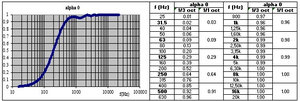
The output data above, regarding the normal-incidence absorption coefficient (α₀ i.e. alpha0), are comparable to standardized measurement results (using a Kundt tube):
- cf. ISO 10534-1 (January 2003): Acoustics - Determination of sound absorption coefficient and impedance in impedance tubes - Part 1: Method using standing wave ratio
The "in COPPA0" Excel sheet also displays the real and imaginary parts of the surface impedance for normal incidence (for specialists).
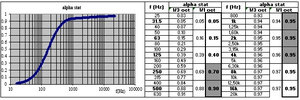
The "in COPPA" Excel sheet also displays other sound absorption performance indicators:
- statistical (random)-incidence sound absorption coefficient (αstat)
- Sabine absorption coefficient (αsab); comparable to standardized measurements: cf. ISO 354 Acoustics - Measurement of sound absorption in a reverberation room
- weighted sound absorption coefficient (αw) and absorption class (1 and A, respectively, for considered example); comparable to standardized measurements: cf. ISO 11654 Acoustics - Sound absorbers for use in buildings - Rating of sound absorption
- NRC and SAA ratings
|
Figure 2 Statistical (random) incidence sound absorption coefficient (αstat) of a material modeled using SILDIS® software for the example under consideration (foam) |
Remark regarding the sound absorption modeling results for a soundproofing material using SILDIS® software (example)
The results of the sound absorption modeling for the soundproofing material shown above are valid under the assumption of an impervious rigid back, condition that corresponds to how this performance indicator is determined in the laboratory (using either a standing-wave tube or a reverberation room). However, this is not the only assumption that can be used with the software; it is also possible to apply a "rear atmosphere" i.e. air backing boundary condition for computations relating to the modeled acoustic structure (requiring the modification of just a single Excel cell in the calculation program) and thereby obtain (instantly) the results shown in Figure 3 below.
|
Figure 3 Normal-incidence sound absorption coefficient (α₀ i.e. alpha0) of a material modeled using SILDIS® software for the example under consideration (foam); unlike figure 1: without an impervious rigid back but with a rear atmosphere instead |
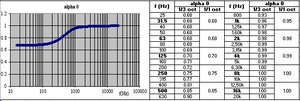
The performance indicator i.e. the normal-incidence sound absorption coefficient (α₀ i.e. alpha0) is significantly higher (meaning "better" in practice) at low and medium frequencies, as shown in Figure 3 compared to Figure 1; the same applies to the statistical (random) incidence sound absorption coefficient (αstat); this was verified in the case at hand, although the comparison results are omitted here to avoid cluttering the presentation.
Consequently - and generally speaking - when preparing a calculation report involving the absorption coefficient of a multilayer acoustic insulation panel composed of a sound-absorbing material (such as the foam used in this example, or other materials like various types of wool e.g. rock, glass, or polyester - which are more commonly used in industrial soundproofing contexts - potentially with a facing and a perforated sheet) and a metal sheet (often steel), one may use a sound absorption coefficient value for the resulting assembly (i.e. the multilayer panel) that:
- is derived from measurements - performed solely on the sound-absorbing material (the foam, in this example) - using either a standing-wave tube or a reverberation room; this is a common practice for those who do not have access to SILDIS® software, as such data are generally the only ones available. This imperfectly reflects reality, as the approach implies a boundary condition at the rear of the acoustic structure that does not account for actual field conditions (in situ, there is no "impervious rigif back" i.e. "rigid, impermeable backing" behind a soundproofing panel used in a noise barrier or enclosure context; there is air)
- depending on the nature of the sheet metal (it is not always steel; it may be aluminum) and its thickness - not to mention potential orthotropy e.g. in case of claddings with corrugations - its behavior will deviate to varying degrees from that of an impervious rigid back. The latter assumes a total absence of sound transmission through the rear of the acoustic structure, what is a questionable assumption for sheet metal as thin as one millimeter (common in machinery and industrial equipment enclosures, unless the thickness is a fraction of a millimeter) because the sound transmission loss (characterizing performance in limiting noise transmission) is very low at very low frequencies (a drawback that is further exacerbated when the density of the sheet metal material is lower)
- is resulting from a simulation using SILDIS® software (considering the entire acoustic structure of the multilayer panel i.e. including the sheet metal, modeled as "set 0" to reflect its position behind "set 1" and applying a "rear atmosphere" condition at the back. This is an approach that anyone is free to consider - in principle - more promising in terms of robustness, as it is better able to account for the physical phenomena inherent to the design context
[0] Sound Impact Limitation - Design for Industrialized Solutions