The SILDIS®[0][1] software (in Excel format) enables the simplified calculation of the sound reduction index of a double-leaf wall, as illustrated by an example (numbered 2.4.2 in the User's manual), combining theoretical aspects and empirical data, with an approach wich is distinguished by:
- the simplicity of the prediction method, which contrasts with the sophisticated modeling and calculation routines implemented elsewhere in the SILDIS® software (specifically when results are displayed in the "in-out COPPA" worksheet)
- the fact that connections between the leaves (facings) are taken into account
Such a simplified calculation of the sound reduction index for double-leaf partitions is particularly in case of:
- linear connections involving partitions made of combinations of thin sheets (e.g. metal sheets, plasterboard, wood panels)
- point connections for lagging systems (e.g. for a masonry wall with insulation and plasterboard)
Within the software, this calculation is performed using the Excel worksheet that centralizes input data for acoustic layers ("in-COALA"), with results displayed in a specific Excel worksheet named "in-out COPPA2" (dedicated to double-leaf partitions, i.e. those with 2 leaves).
Problem statement for the simplified calculation of the sound reduction index of a double-leaf partition using SILDIS® software (example)
The objective is to calculate the diffuse-field sound reduction index of a double-leaf partition comprising (from back to front):
- a steel sheet [1] with a thickness of 0.002 m [2], accounting for the material's intrinsic losses (using the INT model [3]) and selecting a model without empirical correction (NAT) for the effective critical frequency [4]
- an aluminum sheet [5] with a thickness of 0.002 m [6], accounting for the material's intrinsic losses (using the INT model [7]) and selecting a model without empirical correction (NAT) for the effective critical frequency [8]
- between the two: an air gap [9] with a thickness of 0.05 m [10] and a rock wool layer [11] with a density of 45 kg/m³ [12] and a thickness of 0.05 m [13]
The prediction is performed assuming air at 20°C [14] and a pressure of 101,325 Pa [15].
The general SHA3 model is selected to calculate the sound reduction index Rdif [16], assuming linear connections (L-L model) [17] with a spacing of 0.6 m [18]. The language used is French [19].
The calculations involves are of practical interest, possibly in the context of engineering or Research and Development (R&D) projects, for the sizing of various soundproofing products and systems (potentially with other materials):
- limiting sound transmission using acoustic insulation panels, walls, partitions, noise barriers, floors, and roofing for industrial structures or in the building sector
Input data to be entered for the simplified calculation of the sound reduction index of a double-leaf partition using SILDIS® software (example)
To perform the simplified calculation of the sound reduction index for the example double-leaf partition using Module 2 of the SILDIS® software, the following input data must be entered:
- partly in the "in-COALA" Excel worksheet (type, models, temperature, and thickness of the material layers making up the acoustic structure)
- partly in the "in-out COPPA2" Excel worksheet (specifics regarding the double-leaf partition)
The input data required for the calculation are listed below, referencing the information provided earlier (see the numbers in brackets in the previous section, which serve as markers for the selection described below). Input cells are identified by their Excel coordinates (column/row) in the following excerpt from the user manual.
Input data to be entered in the "in COALA" Excel worksheet
| Item | Cell for input | Foreseen action | Input | Landmark / comment |
| Language | AF2 | For English, select E,; for French, select F | E | [19] |
| Temperature (°C) | D5 | Enter a real number | 20 | [14] |
| Pressure (Pa) | D6 | Enter a positive real number | 101325 | [15] |
| Reference for porous media | J21 | Select a model (in a drop-down menu) | AIR, RW45 | [9], [11], [12] |
| General model for porous media | J27 | Select a model (in a drop-down menu) | AIR, M84R | [9], [11] |
| Thickness (m) | J56 | Enter a positive real number | 0.05, 0.05 | [10], [13] |
| Reference for thin plates | AB59 | Select a model (in a drop-down menu) | STEEL, ALU | [1], [5] |
| Model for losses | AB66 | Select a model (in a drop-down menu) | INT, INT | [3], [7] |
| Model for effective critical frequency | AB67 | Select a model (in a drop-down menu) | NAT, NAT | [4], [8] |
| Number of identical plates | AB68, AC68 | Enter a positive real number | 1, 1 | imposed entry[1] |
| Thickness of plates (m) | AB69 | Enter a positive real number | 0.002, 0.002 | [2], [6] |
Remarks:
- since the material considered for the thin plate in the example is one of those with properties listed in a library, the user does not need to enter them manually (in cells AF60 onwards) and then select "BYO" (Bring Your Own) from the material reference drop-down menu in cell AB59
- for a calculation with imax=0, the user must select either 1 or 2 from the drop-down menu in cell AD59, depending on whether he wishes to assign the properties of the thin plate(s) in set 1 or set 2 to the thin plate(s) in set 0 - with the exception of the number of unbonded stacked plates, which may differ for set 0 depending on the specific input -
Input data to be entered in the " "in-out COPPA1" in COALA" Excel worksheet
| Item | Cell for input | Foreseen action | Input | Landmark / comment |
| General model for Rdif | K79 | Select a model (in a drop-down menu) | SHA3 | [16] |
| Model for connections | K85 | Select a model (in a drop-down menu) | L-L | [17] |
| Distance between line-type connections (m) | K88 | Enter a positive real number | 0.6 | [18] |
Output data: results of the simplified calculation of the sound reduction index for a double-leaf partition using SILDIS® software (example)
For the example under consideration, the results of the wall sound reduction index calculation using SILDIS® software can be viewed:
- in the "in-out COPPA1" Excel sheet, regarding the diffuse-field sound reduction index (Rdif), as shown in Figure 1 below:
- curve: narrow-band (i.e. per 1/21-octave frequency bands); table: per 1/3-octave and 1/1-octave frequency bands
|
Figure 1 Sound reduction index of a double-leaf partition with connections between leaves: simplified calculation using SILDIS® software |
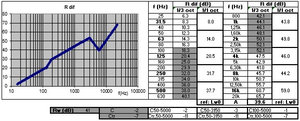
The main result of the acoustic attenuation modeling for the wall in question is, in the compact format required by current standards: Rw(C;Ctr) = 41(-2;-7)
The output data above, regarding the sound reduction index, are comparable to the results of standardized measurements:
- sound reduction index for diffuse (random) incidence, Rstat: cf. ISO 140-3 Acoustics - Measurement of sound insulation in buildings and of building elements - Part 3: Laboratory measurement of airborne sound insulation of building elements
- weighted sound reduction index Rw and correction terms C and Ctr: cf. ISO 717-1 Acoustics - Rating of sound insulation in buildings and of building elements – Part 1: Airborne sound insulation
Adjusting certain software input data (e.g. physical properties such as the modulus of elasticity i.e. Young's modulus or model settings e.g. using TOT internal losses instead of INT, or the effective critical frequency GER or NF instead of NAT) would yield (slightly) different results.
For "internal use" i.e. in case ITS human ressource is performing the computation, selecting a general model within the "in-out COPPA1" Excel sheet that accounts for connection elasticity (along with the entry of the corresponding input data) would allow for a more refined forecast.
[0] Sound Impact Limitation - Design for Industrialized Solutions