The transfer of energy between a rotating part (a rotor) and a fluid (a liquid in the case of a pump, air in the case of a compressor, another gas in the case of a combustion turbine), which forms the basis of turbomachinery operation, is accompanied by very significant noise emissions, characterized by a very high sound power level over a wide frequency range. Noise treatment of turbomachinery is necessary for various reasons:
- from the perspective of the health of employees (and also of external contractors) ensuring the operation and maintenance of facilities with such ultra-noisy equipment. European Directive 2003/10/EC concerning the minimum health and safety requirements regarding the exposure of workers to the risks arising from physical agents (noise) is a reference document, fixing:
- limit exposure values for workers to noise: exposure level L EX,8h = 87 dB (A) and peak sound pressure pcrête = 200 Pa or 140 dB (C) ref. 20 μPa
- lower exposure values for workers to noise triggering action: exposure level L EX,8h = 80 dB (A) and peak sound pressure pcrête = 112 Pa or 135 dB (C) ref. 20 μPa
- higher exposure values for workers to noise triggering action: exposure level L EX,8h = 85 dB (A) and peak sound pressure pcrête = 140 Pa or 137 dB (C) ref. 20 μPa
- with regard to respect for the environment, and in particular the peace and quiet of the neighborhood, if only to avoid complaints and administrative disputes. French regulations, if applied, distinguish between the daytime period (7:00 a.m. to 10:00 p.m. except Sundays and public holidays) and the nighttime period (10:00 p.m. to 7:00 a.m. as well as Sundays and public holidays):
- in some cases, a prefectural decree (when it is not ministerial) sets the noise levels not to be exceeded at the property boundary: this is particularly the case for Facilities Classified for the Protection of the Environment (FCPE) e.g. 70 dB(A) during the day and 60 dB(A) at night
- emergence i.e. the difference between the equivalent continuous A-weighted pressure levels of ambient noise (turbomachinery in operation) and residual noise (in the absence of the turbomachinery, but measured over the period of operation of the turbomachinery) is limited in the Regulated Emergence Zones (REZ), which generally include, near the turbomachinery: homes, building zones and areas occupied by third parties e.g. Public Access Buildings (PAB), other industrial establishments. If the ambient noise level in the REZ (including the turbomachinery noise) is between 35 dB(A) and 45 dB(A) then the admissible emergence is 6 dB(A) during the day and 4 dB(A) at night. If the ambient noise level in the REZ (including turbomachinery noise) is greater than 45 dB(A) then the admissible emergence is 5 dB(A) during the day and 3 dB(A) during the night.
- in the case of a Facility Classified for the Protection of the Environment (FCPE), the marked tone, the presence of which is linked to the difference between the sound pressure level in a given 1/3 octave frequency band and the adjacent frequency bands, is considered undesirable if it exceeds 10 dB in the frequency range 50 Hz-315 Hz or 5 dB in the frequency range 400 Hz-8000 Hz
ITS participated in the treatment of turbomachinery noise at an Oil & Gas site in the Persian Gulf.
For two combustion turbines (over 80 MW in simple cycle, approximately 120 MW in combined cycle), the noise sources targeted by the soundproofing measures described in this post were the combustion turbines themselves and the generators associated with their operation for electricity production. High-performance acoustic buildings with a metal frame and various construction elements were therefore considered for each unit:
- for fixed or easily removable parts, by elements: industrial soundproofing panels with an absorbing face (modular)
- for acces: (rotating) acoustic doorsets with, for translucent parts (with glazing guaranteeing residual safety in the event of accidental breakage): acoustic window sets
In addition, the ventilation air inlets and outlets are equipped with ventilation silencers (to avoid the transmission of noise through openings required for the evacuation of the very important thermal power dissipated by the enclosed equipment).
Given the stakes associated to such a project - the objective being a sound pressure level below 85 dB(A) at 1 meter from the enclosures inside which the gas turbines have a sound power level exceeding 140 dB(A) - noise reduction calculations, using a proven methodology, were of course essential. These calculations took into account the characteristics of the acoustic field inside the sound enclosures (more or less diffuse depending on the sound absorption characteristics of the partitions), the sound reduction of the partitions (panels forming the walls and roof, silencers), and sound propagation modalities in their environment, where the assumption of radiation from a point source is not valid at short distances. In this regard, the SILDIS software developed by ITS human resources allows the simulation of the performance of construction elements (with Module 1 - prediction of the acoustic and aerodynamic performance of silencers - and Module 2 - prediction of the acoustic performance of flat walls -), Module 10 - prediction of the sound emissions of buildings and other constructions - allowing the simulation of the sound impact in different locations of interest, including in the near acoustic field.
Regarding the studies, such a project also required:
- calculations of the mechanical resistance of the structures, which had to comply with various design codes and regulations
- aerodynamic calculations for sizing the ventilation systems, a key factor (among others) for the success of such projects (for the habitability of the enclosures for service personnel and for the integrity of some sensitive electronic components)
- an electrical study for the fans and sensors associated with the ventilation system
As regards production, the use of carefully selected raw materials, state-of-the-art methods and techniques for construction, assembly and anti-corrosion painting have enabled, according to cycles proven in terms of organization and quality, and without any delays, the provision of soundproofed buildings in kits, meeting the best quality standards - as imposed by a demanding Client - ready to be assembled on site without a hitch to allow for a noise treatment of the turbomachinery of this facility being both effective and sustainable, which is the hallmark of ITS and of its commercial partners.
Spread the word !
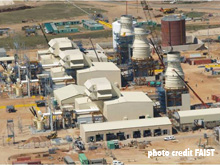
Noise treatment of turbomachinery by means of sound enclosures similar to those covered by this article |
In addition to soundproof buildings, sound enclosures and noise-barrier walls, ITS markets, in terms of noise treatment for turbomachinery (visible in the photo opposite but not delivered as part of the project subject of this article) soundproofed air intake systems for combustion turbines / gas turbines, exhaust silencers for combustion turbines / gas turbines, and also Vent silencers for pressurized gas | |