When one is looking to obtain a noise reduction, ITS offers a wide range of exhaust silencers for combustion turbines / gas turbines for all applications related to acoustic insulation / soundproofing (protection of workers against noise, preservation of acoustic environment) in relation to the limitation of noise emissions in the energy sector.
The noise source requiring attenuation frequently exceeds 150 dB(A) in terms of overall sound power level (distributed across a very wide frequency range) at the turbine outlet flange - a substantial figure - while standard exhaust system components provide only minimal noise attenuation, and may even generate their own flow noise:
- in simple-cycle operation: quite often an elbow (except for certain units, e.g. low-power ones) to redirect the exhaust gas flow from horizontal to vertical, and - invariably - a stack
- in combined-cycle operation: a diverter (term commonly used, even by French speakers) that modulates gas flow (albeit generating aerodynamic noise due to turbulence caused by the moving flap) and directs all or part of the gas stream:
- potentially toward a boiler i.e. a Heat Recovery Steam Generator - HRSG, acronym commonly used, even by French speakers - where noise attenuation (which varies with frequency) is often uncertain (known only through manufacturer data, which was likely difficult to determine regardless of the methodology used, and possibly based on operating conditions not all invariable); followed downstream by a change in gas flow direction and - of course - a stack
- potentially toward a bypass stack (term ommonly used, even by French speakers)
An exhaust silencer for a combustion turbine (or gas turbine) - when correctly sized - is the aeraulic circuit whose performance can be precisely quantified and on which one can rely in practice to consistently remain on the right side of regulatory noise limits; provided that its efficiency is not reduced by downstream circuit components (in the case of a combined-cycle installation: the boiler, and in all cases: the chimney, the cross-section of which must be sufficient to prevent excessive fluid velocity at the outlet plane, which could generate unwanted noise).
The effectiveness of such an equipment:
- often determines the installation's compliance, as the residual sound power level at the stack outlet must - thanks to the silencer - be low enough to avoid causing a nuisance
- impacts the installation's efficiency, as the total pressure loss caused by the silencer must be low enough to avoid significantly reducing the electrical power output
The design and construction quality of such equipment affects its service life, given operating conditions known to place it under severe stress:
- during system operation: involving very high-temperature (with the notable exception of a silencer installed downstream of a HRSG, operating at a temperature below 100°C), high-velocity gases that must not degrade the silencer's lining materials or impair their performance
- during system startup and shutdown: involving thermal expansion of metal components that must not lead to deformations compromising the silencer's structural integrity (which could then possibly cause constriction of the airflow paths - increasing pressure drop and thus reducing power output - or even lead to disintegration with potentially catastrophic consequences, extending beyond mere loss of production)
Experience counts when it comes to the engineering tasks (acoustics, fluid mechanics, materials science, structural mechanics, and sizing of all kinds) and the manufacturing (welding and other assembly methods) of silencers that deliver lasting performance: the experience possessed by ITS and its commercial partners is precisely the kind that matters in this highly specialized field.
General information regarding exhaust silencers for combustion turbines/gas turbines marketed by ITS
Range of applications
- reduction of noise impact of decentralized power plants or of heavy duty power generation plants
Benefits
- excellent technical characteristics and robustness
- ease of implementation (easy assembly/disassembly)
- high adaptability of acoustic performance
- high level of standardization
Characteristics of exhaust silencers for combustion turbines/gas turbines marketed by ITS
Presentation
- an envelope being rectangular or circular, metallic, double shell (perfect mechanical resistance over time) with an upstream connecting flange and with a downstream connecting flange and with thermal insulation
- splitters (sometimes called: baffles) generally parallelepipedic (except for silencers with a circular cross section), with metallic frames and structures
- thickness, filling (usually mineral wool or special glass wool), finishes, free open area, geometry of upstream and downstream ends: adapted depending on the desired performance
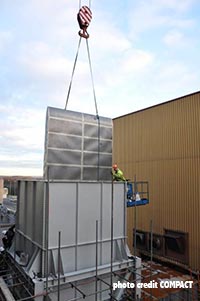
exhaust silencer |
Construction
- in case of a silencer with a rectangular cross section, the soundproofing device is in the form of a box-piece generally monobloc
Standard constitution (for rectangular or square cross section)
- casing made of steel sheet, thickness according to performance requirements, with connecting flanges upstream and downstream
- splitters (sometimes called: baffles) rectangular, with steel frames, with a profiled upper extremity for back pressure limitation
- filling made of mineral wool (e.g rockwool, basalt wool) or special glass wool with a cover made of fabric (glass fabric in some cases)
- perforated facing made of steel sheet, thickness according to performance requirements (other finish upon request)
Splitter baffles are, of course, crucial for the effectiveness of exhaust silencers for combustion/gas turbines:
- in terms of performance (acoustic and aerodynamic)
- in terms of durability (resistance to erosion, oxidization, and thermal stress)
The baffles used in silencers marketed by ITS are carefully designed and manufactured:
- premium-grade materials
- surfacings preventing degradation caused by high gas velocities and temperatures (needled mat, fabric, and perforated sheet metal)
Depending on specific project requirements, they can be:
- conventional i.e. with a height matching that of the silencer casing
- alternately oriented (then, in general resulting in substantial noise attenuation - meeting relevant requirements - while offering lower total pressure loss due to a larger flow area and flow-equalizing effect, as well as better thermal stress management)
The rectangular or square-section exhaust silencers marketed by ITS are suitable for all gas/combustion turbines, with no known limitations regarding size, power output, or operating conditions. Their modular design makes them particularly well-suited for shipment in parts (often in containers) and for quick, easy on-site installation. Silencers featuring sound-absorbing lining in the form of concentric rings, on the other hand, are generally reserved for small-capacity gas/combustion turbines, allowing the range to be comprehensive.
Weather resistance
- outdoor use in all kinds of environments
Acoustic and aerodynamic performance
- simulated - Insertion loss, flow noise and total pressure loss. Non standard performance can be obtained by the means of special constructions. Depending on the case:
- for conventional rectangular baffles and sound-absorbing lining in the form of concentric rings: using SILDIS® software based on an analytical approach for acoustic performance (without flow noise), and using measurement-based regressions for self-generated noise and aerodynamic performance
- for baffles with alternating orientation: using software simulations based on the Finite Element Method (FEM - acronym commonly used, even by French speakers -) and Computational Fluid Dynamics (CFD - acronym commonly used, even by French speakers -)
Associated products and services (on request)
- other components of exhaust systems. Complete study. On-site installation (national and international)
Silencer
 |
Sorry, no dedicated brochure downloadable presently (however: available equipment) |
 |
See the frequently asked questions related to this equipment |
ITS offers exhaust silencers for combustion turbines, gas turbines for power plants workers protection and for environment preservation against noise.
Exhaust silencer for combustion turbines / gas turbines, noise diminution device for combustion turbines / gas turbines exhaust, noise limitation device for combustion turbines / gas turbines exhaust, noise reduction device for combustion turbines / gas turbines exhaust : all equipment that one can source thanks to Isolation Technologie Services (ITS).