ITS participated in the noise reduction of a gas-fired power plant in the Middle East, the use - in the context of this project - of a combustion turbine with a power output of around 140 MW being accompanied by very significant noise emissions, which could not not be treated specifically, if only to comply with regulations:
- for what has to do with the hearing health of staff at such a site. European Directive 2003/10/EC concerning the minimum health and safety requirements regarding the exposure of workers to the risks arising from physical agents (noise) is a reference document, fixing:
- limit exposure values for workers to noise: exposure level L EX,8h = 87 dB (A) and peak sound pressure pcrête = 200 Pa or 140 dB (C) ref. 20 μPa
- lower exposure values for workers to noise triggering action: exposure level L EX,8h = 80 dB (A) and peak sound pressure pcrête = 112 Pa or 135 dB (C) ref. 20 μPa
- higher exposure values for workers to noise triggering action: exposure level L EX,8h = 85 dB (A) and peak sound pressure pcrête = 140 Pa or 137 dB (C) ref. 20 μPa
- for what has to do with the quietness of the neighborhood. French regulations, if applied, distinguish between the daytime period (7:00 a.m. to 10:00 p.m. except Sundays and public holidays) and the nighttime period (10:00 p.m. to 7:00 a.m. as well as Sundays and public holidays):
- in some cases, a prefectural decree (when it is not ministerial) sets the noise levels not to be exceeded at the property boundary: this is particularly the case for Facilities Classified for the Protection of the Environment (FCPE) e.g. 70 dB(A) during the day and 60 dB(A) at night
- emergence i.e. the difference between the equivalent continuous A-weighted pressure levels of ambient noise (power plant in operation) and residual noise (in the absence of the power plant, but measured over the period of operation of the power plant) is limited in the Regulated Emergence Zones (REZ), which generally include, near the power plant: homes, building zones and areas occupied by third parties e.g. Public Access Buildings (PAB), other industrial establishments. If the ambient noise level in the REZ (including the power plant noise) is between 35 dB(A) and 45 dB(A) then the admissible emergence is 6 dB(A) during the day and 4 dB(A) at night. If the ambient noise level in the REZ (including power plant noise) is greater than 45 dB(A) then the admissible emergence is 5 dB(A) during the day and 3 dB(A) during the night.
- in the case of a Facility Classified for the Protection of the Environment (FCPE), the marked tone, the presence of which is linked to the difference between the sound pressure level in a given 1/3 octave frequency band and the adjacent frequency bands, is considered undesirable if it exceeds 10 dB in the frequency range 50 Hz-315 Hz or 5 dB in the frequency range 400 Hz-8000 Hz
As for the means implemented to reduce the noise of the combustion turbine itself and the generator whose (coupled) operation forms the basis of the production of the gas-fired power plant in question, these involved very large enclosures, with a metal framework and with various construction elements:
- for fixed or easily removable parts, by elements: industrial soundproofing panels with an absorbing face (modular)
- for acces: (rotating) acoustic doorsets with, for translucent parts (with glazing guaranteeing residual safety in the event of accidental breakage): acoustic window sets
In addition, the ventilation air inlets and outlets are equipped with ventilation silencers (to avoid degradation of overall acoustic performance at the ventilation openings, without which the temperature rise would exceed acceptable limits for maintenance personnel and for some sensitive electronic equipment).
Achieving a sound pressure level below 85 dB(A) at 1 meter from the enclosures necessitated a thorough acoustic study for selecting the construction elements (walls, roof panels, silencers), taking into account the sound propagation modalities both inside the enclosures (with noise levels amplified by reverberation) and outside, in the near acoustic field. The scope of the engineering work also included:
- calculations of the mechanical resistance of the structures, to insure the necessary stability in all circumstances (e.g. wind, partial dismantling of the casings for maintenance)
- aerodynamic calculations for sizing air renewal systems with noise attenuators
- an electrical study for the fans and sensors associated with the ventilation system
The production of the enclosures intended for the noise reduction at the gas-fired power plant mobilized a highly qualified human resource, experienced in sub-assemblies machining and assembly techniques for the delivery within the announced deadlines, of assemblies distinguished by the rigor and ingenuity of their design, the quality and robustness of their manufacture to satisfy a demanding Client, who knows that he can count in such cases on ITS and its commercial partners.
Spread the word !
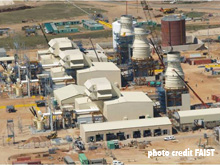
Noise reduction in a gas-fired power plant by means of sound enclosures similar to those covered by this article |
In addition to soundproof buildings, sound enclosures and noise-barrier walls, ITS markets, in terms of noise reduction of gas-fired power plants (visible in the photo opposite but not delivered as part of the project subject of this article) soundproofed air intake systems for combustion turbines / gas turbines, exhaust silencers for combustion turbines / gas turbines, and also Vent silencers for pressurized gas | |