Noise abatement in a production facility is necessary for several reasons:
- as regards the health and well-being of employees, which must be preserved by offering them sufficiently good working conditions, if only to avoid the decline in the quality of production, absenteeism, hearing injuries and accidents possibly resulting from excessive fatigue or stress, or even from the failure to perceive audible warning signals. Prolonged use of noise-canceling headphones - which do not always offer sufficient hearing protection, depending on the frequency distribution and on level of noise - can cause discomfort, limiting the possibilities of oral communication with colleagues: collective protection measures are often preferable. European Directive 2003/10/EC concerning the minimum health and safety requirements regarding the exposure of workers to the risks arising from physical agents (noise) is a reference document, fixing:
- limit exposure values for workers to noise: exposure level L EX,8h = 87 dB (A) and peak sound pressure pcrête = 200 Pa or 140 dB (C) ref. 20 μPa
- lower exposure values for workers to noise triggering action: exposure level L EX,8h = 80 dB (A) and peak sound pressure pcrête = 112 Pa or 135 dB (C) ref. 20 μPa
- higher exposure values for workers to noise triggering action: exposure level L EX,8h = 85 dB (A) and peak sound pressure pcrête = 140 Pa or 137 dB (C) ref. 20 μPa
- with regard to respect for the environment, and in particular the peace and quiet of the neighborhood, if only to avoid complaints and administrative disputes. French regulations, if applied, distinguish between the daytime period (7:00 a.m. to 10:00 p.m. except Sundays and public holidays) and the nighttime period (10:00 p.m. to 7:00 a.m. as well as Sundays and public holidays):
- in some cases, a prefectural decree (when it is not ministerial) sets the noise levels not to be exceeded at the property boundary: this is particularly the case for Facilities Classified for the Protection of the Environment (FCPE) e.g. 70 dB(A) during the day and 60 dB(A) at night
- emergence i.e. the difference between the equivalent continuous A-weighted pressure levels of ambient noise (production facility in operation) and residual noise (in the absence of production facility noise, but measured over the period of operation of the production facility) is limited in the Regulated Emergence Zones (REZ), which generally include, near the production facility: homes, building zones and areas occupied by third parties e.g. Public Access Buildings (PAB), other industrial establishments. If the ambient noise level in the REZ (including the industrial site noise) is between 35 dB(A) and 45 dB(A) then the admissible emergence is 6 dB(A) during the day and 4 dB(A) at night. If the ambient noise level in the REZ (including industrial site noise) is greater than 45 dB(A) then the admissible emergence is 5 dB(A) during the day and 3 dB(A) during the night.
- in the case of a Facility Classified for the Protection of the Environment (FCPE), the marked tone, the presence of which is linked to the difference between the sound pressure level in a given 1/3 octave frequency band and the adjacent frequency bands, is considered undesirable if it exceeds 10 dB in the frequency range 50 Hz-315 Hz or 5 dB in the frequency range 400 Hz-8000 Hz
ITS participated in noise abatement in an electricity production facility using combustion turbines in Central Asia.
The project involved designing and constructing two large enclosures with reinforced acoustical insulation, with a metal frame and various construction elements, which also form the basis of numerous noise treatment products (canopies, acoustic screens and noise barriers, soundproofed buildings) marketed by ITS (in addition to silencers of all kinds):
- for fixed or easily removable parts, by elements: industrial soundproofing panels with an absorbing face (modular)
- for acces: (rotating) acoustic doorsets with, for translucent parts (with glazing guaranteeing residual safety in the event of accidental breakage): acoustic window sets
In addition, the ventilation air inlets and outlets are equipped with ventilation silencers (to ensure the necessary continuity of sound insulation).
In terms of design, such a project required:
- structural calculations, complying with various design codes and regulations (taking into account site-specific factors such as rain, snow, wind, and seismicity)
- acoustical calculations with modeling of noise propagation: considering the amplification phenomenon within the enclosure, the acoustic attenuation of its wall elements (mentioned above), and the spatial sound decay outside (in a more or less free acoustic field)
- airflow calculations for efficient ventilation, capable of evacuating air heated by the thermal emissions of the enclosed equipment
- an electrical study for fans and sensors associated with the ventilation system
In terms of construction, the project involved prefabrication in a workshop, using carefully selected raw materials and highly technical forming, assembly, and anti-corrosion painting techniques to obtain a flawless finished product that meets the highest quality standards - rigorously controlled - required by clients in a cutting-edge industry that tolerates no delays or defects.
The noise abatement equipment in this production facility will ensure that the sound pressure level durably remains below 85 dB(A) at 1 meter from the enclosures - thus meeting the objectives of workers protection and environmental preservation -, as the robustness of the marketed constructions for soundproofing (subjected to harsh conditions in an industrial setting) is not the least quality for ITS and its business partners.
Spread the word !
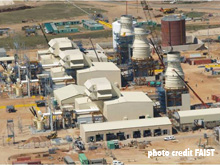
Noise abatement in an electicity production facility by means of sound enclosures similar to those covered by this article |
In addition to soundproof buildings, sound enclosures and noise-barrier walls, ITS markets, in terms of noise abatement means for electricity production facilities (visible in the photo opposite but not delivered as part of the project subject of this article) soundproofed air intake systems for combustion turbines / gas turbines, exhaust silencers for combustion turbines / gas turbines, and also Vent silencers for pressurized gas | |