Software SILDIS (in Excel format) enables the acoustical & aerodynamical modeling of a circular dissipative silencer without pod i.e. without central sound absorbing splitter, what can be illustrated by a case study (referred to as 1.4.2b of User's Manual). With such an assembly:
- acoustic structure is multi-layered with a porous core material (e.g. mineral or polyester wool), and possibly a surfacing (cloth or fabric) or perforated protective layer
- it consists essentially of a peripheral sound absorbing lining (inner diameter being equal to upstream & downstream round duct diameter)
The total presssure loss of such a noise reduction device is very low, due to the lack of obstacle (only the roughness of lining and its length matters when it comes to opposing to flow).
Wording of the problem (envisaged application relating to the calculation of a circular silencer without a central sound absorbing pod with software SILDIS)
It is wished to compute the acoustic and aerodynamic performance of a dissipative silencer with a circular cross section, the area of the duct upstream and downtream (before and after the silencer) being not equal to the area of the overall section of the silencer (overall diameter D0=1400mm [1]) but being equal to the inner width, length L=1500mm [3]), having a lining core layer of thickness d=d1=100mm [5] made of an homogeneous in directions parallel to and perpendicular to its surface bulk absorber having the reference BYOb with flow resistivity 12.5 kNsm-4 [7 ]in the database for porous media of SILDIS modelled as a rock wool with model M76 [8] with a cloth [9] of thickness d’1=5/100 mm [10] having the reference BYO with airlow resistance 30 Nsm3, with mass density 0.090 kg/m2 [11] in the series cloths database of SILDIS without perforated protection [12]. It is foreseen to use the silencer with an air flow rate of 24.1 kg/s [13] at 20 °C [14] at a pressure of 101325 Pa [15]. It is decided to take into account a limitation of the propagation loss for L>1m with model FRO [16] and to take into account the reflection loss with model ZER [17].The reference spectrum is supposed of the type “pink noise” with a sound power level of 130 dB/oct [18]. It is chosen to consider a roughness of lining 1 mm [19]. It is chosen to predict the self noise of the silencer in the way described with the general model 3733c* [20], with the model of thermodynamic correction ZER [21], with the model of spectral correction 3733c [22]. Language to be used is English [23]
|
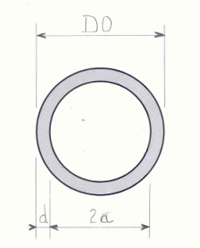
Cross section of a circular silencer without sound absorbing pod - mounting C0 - (d = peripheral acoustical lining thickness, 2a = inner diameter i.e. connection diameter, D0 = overall diameter) |
The calculations involved have practical applications, potentially within the scope of engineering or Research and Development (R&D) projects, for the design of various noise attenuators (which may utilize different paking materials):
- in the building sector, for Heating, Ventilation, and Air Conditioning (HVAC) systems in residential buildings, public-access facilities, and technical areas
- in the industrial sector (inlet and discharge/exhaust systems for fans, motors, and turbomachinery - including compressors and turbines - as well as air-handling systems linked to various processes, including air-cooled condensers and stacks)
Input data (to be entered in Excel worksheets of SILDIS software Module 1)
The input data required for the computation are listed hereafter in reference with the above data (see figures in brackets in the previous §, used as placemarks for explaining the selection below). The input cells are referred to thanks to their Excel’s coordinates (column / line) in the following part extracted from user’s manual.
Worksheet [in COALA] COmputation of Acoustic LAyers
| Item | Cell for input | Foreseen action | Input | See placemark / comment |
| Language | AF2 | For English select E, for French select F | E | [23] |
| Temperature (°C) | D5 | Enter a real number | 20 | [14] |
| Pressure (Pa) | D6 | Enter a real positive number | 101325 | [15] |
| Reference (porous medium) | J21 | Select a reference (material a list) | BYOb | [7] |
| Resistivity (Nsm-4) | M22 | Enter a real positive number | 12500 | [7] |
| General model (porous medium) | J27 | Select a model (in a list) | M76 | [8] |
| Thickness (porous medium) (m) | J56 | Enter a real positive number | 0.09995 | [5]&[10] |
| Incorporation of the series perforated protection (0/1) | J125 | For NO enter 0, for YES enter 1 | 0 | [12] |
| Reference (series cloth) | AB21 | Select a material (in a list) | BYO | [11] |
| Airflow resistance (Nsm-3) | AD22 | Entrer a positive real number | 30 | [11] |
| Mass density (kg/m2) | AD23 | Enter a positive real number | 90 | [11] |
| Incorporation of the series cloth (0/1) | AB26 | For NO input 0, for YES input 1 | 1 | [9] |
| Thickness (series cloth) (m) | AB27 | Enter a real positive number | 0.00005 | [10] |
| Lw0 (dB ref. 1 pW) | C163 to L163 | Enter a real positive number for 1/1 octave band sound power level | 130 | [18] |
Worksheet [in COSIL] COmputation of SILencers
| Item | Cell for input | Foreseen action | Input | See placemark / comment |
| Mounting C0 to get D0 (m) | BB33 | Input a positive real number | 1.400 | [1] |
| h (m) | D34 | Input a positive real number | =BB34 i.e. 0.53174 | [6] |
| Mass flow rate (kg/s) | D66 | Input a real number | 24.1 | [13] |
| Width B (m) | D72 | Input a positive real number | =BC72 i.e. 1.15917 | [1] |
| Height H (m) | D73 | Input a positive real number | =BC73 i.e. 1.15917 | [1] |
| Length L (m) | D74 | Input a positive real number | 1.5 | [3] |
| Model of by-pass correction for L>1m | F83 | Select a model (in a list) | FRO1 | [16] |
| Model of reflection loss | G86 | Select a model (in a list) | ZER | [17] |
| Roughness of lining | F102 | Input a positive real number | 0.001 | [19'] |
| General model for the flow acoustic power | BD106 | Select a model (in a list) | 3733c* | [20] |
| Model of thermodynamic correction | BD107 | Select a model (in a list) | ZER | [21] |
| Model of spectral correction | BD108 | Select a model (in a list) | 3733c | [22] |
Modeling results for a circular dissipative silencer without pod with Module 1 of software SILDIS
Results: key performance indicators for a circular dissipative silencer without pod
Upon completion of the modeling and simulations, and after all calculations, various performance indicators are obtained for the silencer.
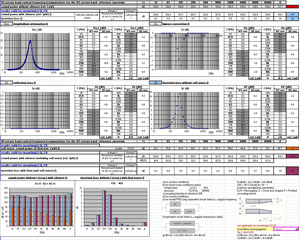
Sound power level with silencer 136.1 dB(A), after consideration of regenerated noise which limits sound attenuation
Silencer insertion loss 1.0 dB(A)
Silencer total pressure loss 4 Pa
One can obverve that the overall acoustical performance (accounting the complete frequency range 20 Hz - 20 kHz) is very limited for the considered case study. The main interest of such a silencer is its efficiency in 1/1 octave band with central frequency 250 Hz, especially in 1/3 octave bands of central frequency 315 Hz & 400 Hz where the insertion loss without flow noise reaches respectively 14.0 & 15.1 dB. If needed, a higher performance and/or a different frequency for its maximum could be achieved by increasing the thickness/modifying the flow resistivity of the sound absorbing material; however no significant efficiency one should expect for high frequency from such a straight trough noise reduction device with a so big transverse dimension i.e. inner diameter.
Results: screenshots of worksheet [in-out CODIS2] (COmputation of DISsipative silencers) of Module 1 of software SILDIS for a circular dissipative silencer without pod
Acoustics
In what follows, performance indicators are linked by the formulas Di’ = Da.L + Dc + Dr ; Lw1 = 10 * log [10^ (0.1 * (Lw0 – Di’)) + 10^ (0.1 * Lw)] ; Di = Lw1 - Lw0
|
Result of the modeling of the acoustic performance of a circular dissipative silencer without sound absorbing pod with software SILDIS |
Aerodynamics/aeraulics
In what follows, performance indicators are linked by the formulas Δpt = ζf * 0.5 * ϱ * (Vf) 2 = ζp * 0.5 * ϱ * (Vp) 2 with ϱ = density (kg/m3), Vf = front speed (m/s), Vp = passage speed (m/s)
|
Result of the modeling of the aeraulic/aerodynamic performance of a circular dissipative silencer without sound absorbing pod with software SILDIS |
-modeling-dissipative-circular-silencer-without-sound-absorbing-pod.jpg)
Remarks regarding the performance of a dissipative circular (without a sound absorbing pod) simulated with Module 1 of software SILDIS
The input data and the outcome displayed in the previous sections are those of the version of Module 1 of the SILDIS software usually marketed; some cells (e.g. model selections for different computation stages) are pre-filled by default with robust selections (that the user can change) for the considered silencer mounting. In order to limit questions from users possibly not familiar with some of the input data to be entered (in relation to what user's manual might be helpful, and dedicated training as well), it is possible to restrict the features of the software package by preventing the modification of some settings for different stages of the computations (to an extend varying on foreseen applications), in oder to make sizings with SILDIS even easier and faster.
The Module 1 of software SILDIS allows acoustical & aerodynamical (aeraulic) modeling of dissipative circular dissipative silencers without sound absorbing pod (i.e. straight through type):
- not exclusively using english language: french can be used too (also for entering input data)
- possibly in line with the methodology of some engineers associations (when appropriate models are selected in software drop-down menus)
- possibly comparable with some laboratory measurement standards e.g. ISO 7235 Acoustics - Laboratory measurement procedures for ducted silencers and air terminal units- Insertion loss, flow noise and total pressure loss (when appropriate models are selected in software drop-down menus)
- which can be obtained in less than 10 minutes only, including time necessary for data entry in a way similar to the sizing of silencers with a rectangular cross-section, for which a demonstration video is available elsewhere[1]
The Module 1 of software SILDIS also allows silencer modeling in cases being - sometimes: by far - more demanding than case study above, as some industrial contexts may involve:
- with more complex service conditions e.g. increased temperature, increased pressure, increase fluid speed in airways, fluid being not dry air
- with sound absorber being not only rockwool (e.g. glass wool, polyester wool, foam of various kinds), possibly with more sophisticated modeling of acoustical behaviour beyond the consideration of sole flow resistivity e.g. with the consideration of porosity, tortuosity, thermal & viscous charactersitic lengths (in some versions of the software, libraries are available)
- with more complex acoustic structure for the sound absorbing filling e.g. with perforated sheets namely when open area ratio is too low to allow its influence to be neglected (as for the case study discussed above)
- with other geometries e.g. with central pod (then with or without peripheral lining), with square cross section, with rectangular cross section (with ordinary or pine-tree shaped splitter baffles); regarding dissipative silencers with a circular cross-section, it is also possible to account geometries with sound absorbing linings in the form of concentric rings
For the considered case study, recourse was made to the so-called Terminal 2 of the Module 1 of the software - relating to mounting C0 - of which results are extrapolated from the consideration of sound propagation between facing plane surfaces as envisaged in Terminal 1 of the same module of the software, whereas Terminal 3 of the same module of the software - relating to mounting C0A - would be appropriate too, then based on the use of Bessel functions, e.g. for calculating the surface impedance of the curvilinear sound-absorbing lining. A good agreeement is observed between both approaches, when the silencer diameter is sufficiently big; otherwise, Terminal 3 - relating to mounting C0A - developped more recently - quite a long time ago however - is preferable, unless size is so big that the computation of Bessel functions is an issue due to a very large complex argument (asymptotic estimates then always being possible with SILDIS software).
With Module 1 of the SILDIS software, solving the sound propagation equation in the silencer's air passages and in the sound-absorber by means of an analytic method forms the basis for simulating the propagation loss - a fundamental component of acoustic performance -; therefore, none of the limitations often associated with other approaches pose an obstacle. Laboratory tests - allowing parametric regressions - provide the basis for predicting other performance indicators e.g. the by-pass correction, the self noise and the total pressure loss.
Overview of the methodology used for the evaluation of acoustic & aerodynamic performance indicators of circular dissipative silencers without sound absorbing pod silencers with Module 1 of software SILDIS
| Performance indicator | Propagation loss Da.L | By-pass correction Dc | Reflection loss Dr | Flow noise Lw | Total pressure loss Δpt |
| Methodology | Analytic | Regression based on measurements | Not applicable in case of silencer cross section coresponding to connection diameter equal to that for duct sections upstream & dowstream | Regression based on measurements | Regression based on measurements |
A circular dissipative silencer without pod is not necessarily used alone, especially when its performance is too low compared to the soundprrofing objective of any particular project. It should be noted that some of the output data of software SILDIS Module 1 (i.e. the complex wave number in airway/gallery) can be used as input data for Module 1B in case a dissipative chamber is considered among a cascade of soundproofing elements making an otherwise reactive silencer (muffler). This is true for mounting C0 (round silencer without pod as envisaged in the present case study), as for mouting C1A (circular silencer with pod), and as gfor mounting R (rectangular silencers); the possibilities of combinations for invreased acoustical performance are therefore numerous - especially when one considers that Module 1B allows the consideration of 1 to 3 expansion chambers, each being either purely dissipative or reactive -.
Returning to the C0 assembly, i.e. for a circular dissipative silencer without sound absorbing pod, as modeled in the context of this case study, the applications are varied, as such a noise reduction device is easy to produce (and therefore: cheap) and easy to install; the very low total pressure loss caused makes it suitable for many facilities where higher pressure drop (as involved by rectangular splitter silencers, or by annular silencers i.e. circular silencers with a sound absorbing pod) would not be acceptable for system efficiency (based on the circulation of a specifiied flow rate, not to be diminished by flow obstructions caused by sound absorbing splitter baffles or pods):
- in the building sector, e.g. Heating Ventilation Air Conditioning - HVAC - systems, where the ductwork often has a circular cross-section, at least for the most downstream sections
- in industry (both with regard to protect workers from hearing risks and neighbors from noise annoyance):
- in air ducts or similar systems, including the soundproofing of chimneys for various processes (and some exhaust lines stages as well)
- in pressurized fluid networks of all kinds
- elsewhere too e.g. for the noise reduction of road tunnel air renewal fans
Thus, Module 1 of the SILDIS software allows, with a single Excel workbook and a single data entry, the calculation - combining various models - of the aeraulic and acoustic performance of circular dissipative straight through silencers. Besides insertion loss (i.e. transmission loss with infinite input impedance and anechoic termination), the latter also includes a bypass correction (reflecting the fact that the performance of a 5-meter-long silencer is not five times that of a 1-meter-long silencer), in addition to calculating airflow noise (aka regenerated noise).
In fact, the combination of such features makes the SILDIS software package - at the very least - a valuable sizing tool, especially when the modeling capabilities it offers come along with numerous other advantages:
- Module 1 of the SILDIS software avoids the often tedious (complex, delicate, time-consuming, and costly) tasks associated with other silencer performance prediction strategies, thus offering several stengths (due to the approach based on filling in Excel spreadsheet cells with numerical values and/or selecting models from drop-down menus):
- no specific prerequisites for the user
- light training, as getting started is easy after a very quick initial support session
- no necessity to import or create the silencer geometry, due to programmed parametric configuration
- no necessity to mesh
- the calculation time is not counted in hours, or even minutes (being the same for small silencer or big silencer)
- for some versions of the software, the choice of materials can be made (via drop down menu in software) among library embedded in software:
- for porous media (rock wool, glass wool, basalt wool, polyester wool and ceramic fiber of different densities for wich flow resistivity, porosity, tortuosity, viscous & thermal characteristic lengths are recorded based on laboratory measurements, also with a reference BYO - Bring Your Own - allowing alternatively free enter by user of relevant parameters)
- for series cloths (glass cloth, fabric for wich airflow resistance and mass density are recorded based on laboratory measurements also with a reference BYO - Bring Your Own - allowing alternatively free enter by user of relevant parameters)
- for perforated protections (perforations e.g. round with various diameters with various open area ratios are recorded, also with a reference BYO - Bring Your Own - allowing alternatively free enter by user of relevant parameters)
- the basic investment is limited to a single (multi-user) license with initial onboarding support for getting started; no additional cost for subsequent years to be foreseen, except advanced support if needed whatever the reason
- the license cost is such that even occasional use is sufficient to get shortly return on investment, all the more so when it comes to a software package providing - for example in case of performance of multiple runs - silencer performance predictions that would be more expensive to obtain otherwise (assuming they are then as complete and reliable ?)
Furthermore, can not be compared to SILDIS tools that returns, as a response to a selection query, the performance stored in a database - as some silencer manufacturers have - (or an interpolation of such data), based on measurements (sometimes carried out in time immemorial with poorly documented packing materials or materials that have undergone modifications in terms of the properties induced by their manufacturing methods changes, rarely distinguishing between presence or absence of cloth, fabric or perforated sheet) for a limited number of geometric configurations and which are only valid for air under laboratory conditions (air speed being in general so low that flow direction - with respect to that of the propagation of sound waves - is not accounted).
The Module 1 of software SILDIS (based on Excel) has been made possible by decades of development and validation (in conditions meeting requirement of ISO 9001 relating to quality management systems) in the domain of acoustics (with a specialization in sound propagation and transmission in ducts and multilayer structures) and aerodynamics by a human ressource basing its approcah on the consideration of both theory and practice measurement results (acquired in laboratories, or in-situ). It is a polyvalent, user friendly and reliable tool for sizing circular dissipative silencers without (or else: with) sound absorbing pod in all contexts: from easiests cases (ventilation/air conditioning circuits with ambiant thermodynamic conditions) up to most demanding applications in industry e.g. in energy production sector or for test benches (customizations are possible for a tailor-made tool, even for non specialized users).
Programming, sales, training & assistance are available from one company: Isolation Technologie Services aka ITS. Being available with a near-perpetual licence (100 years), Module 1 of software SILDIS is a must-have for anyone aiming to size silencing devices in the context of sound insulation/noise control projects, for engineering studies as well as for Research & Development (e.g. silencer manufacturers or integrators, engineering companies, acoustic consultants & architects offices).