The SILDIS software (Excel) enables the enables the simulation of the acoustic/aerodynamic performance of a reactive silencer (muffler) with an expansion chamber with a side outlet, as illustrated by an example (numbered 1B.4.5 in the User's manual). Like an ordinary simple expansion chamber, it is a device for attenuating noise:
- without the recourse to sound-absorbing porous materials
- through sound wave reflection phenomena caused by changes in waveguide cross-section (e.g. sudden expansion or contraction) and/or the presence of a rigid back causing a gas flow reversal (resonator effect)
While the inlet and outlet pipes of the expansion chamber are aligned in the EC1 configuration, this is not the case for the EC1SO configuration, where the outlet is perpendicular to the inlet; the gas flow undergoes a change of direction inside the chamber (like other reactive silencers, such a side-outlet expansion chamber exhibits acoustic performance that varies with frequency and, of course, with operating conditions e.g. the nature, temperature, pressure, and flow rate of the gas in question).
Problem statement (envisaged application relating to the computation of a reactive silencer (muffler) with a simple expansion chamber with a side outlet using software SILDIS)
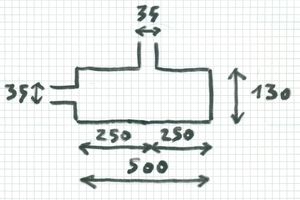
The aim is to calculate the acoustic and aerodynamic performance of a purely reactive silencer [1] featuring a simple expansion chamber, such a mounting being referred to as EC1SO in the software [2], with a circular cross-section, with an inlet and outlet diameter dS = 35 mm [3], a chamber diameter dL = 130 mm [4], and a length L = 500 mm [5], with the axis of the outlet tube positioned at the midpoint of the length of the chamber [6], the length of the inlet tube (flush with the chamber casing) being 110 mm [7], and the length of the outlet tube (flush with the chamber casing) being 110 mm [8]. The silencer is intended for use with a fluid close to clean, dry air [9], with a flow rate of 0.01 kg/s [10] at 19.3°C [11] and a pressure of 100750 Pa [12]. The reference spectrum is assumed to be "pink noise" with a sound power level of 130 dB/octave [13]. Total pressure loss is calculated using the IDE2 model for uniform tubes [14]. Silencer self-noise is calculated according to the general 3733c* model [15], the 3733c thermodynamic correction model [16], and the 3733c spectral correction model [17]. Tube roughness is set to 0.00015 m [18]. The TOF1 added-length model is used [19]. Transmission loss ("TL") is the chosen indicator of acoustic performance (excluding self-noise) [20]. The language used is English [21].
|
Figure 1 Draft (hand drawing) of the simple expansion chamber with a side outlet for the calculation example using the SILDIS software under consideration (dimensions in mm) |
|
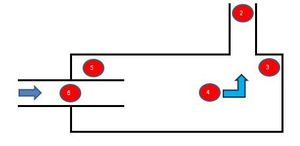
Figure 2 Sketch of a simple expansion chamber with a side outlet (EC1SO) as modeled using SILDIS software; element 6 is the uniform inlet tube (with the smallest diameter), element 5 is an extended inlet, element 4 is a uniform tube (with the largest diameter), element 3 is an extended outlet, and element 2 is the uniform outlet tube (with the smallest diameter) |
Input data for the computation of a reactive silencer (muffler) with a simple expansion chamber with a side outlet (to be entered in Excel worksheets of SILDIS software Module 1)
The input data required for the computation are listed hereafter in reference with the above data (see figures in brackets in the previous §, used as placemarks for explaining the selection below). The input cells are referred to thanks to their Excel’s coordinates (column / line) in the following part extracted from user’s manual.
Worksheet [in COALA]
| Item | Cell for input | Foreseen action | Input | See placemark / comment |
| Language | Z1 | For english, select E, for french select F | E | [21] |
| Temperature (°C) | D7 | Enter a real number | 19.3 | [11] |
| Pressure (Pa) | D8 | Enter a positive real number | 100750 | [12] |
| Dry and clean air ? (0/1) | D10 | For "yes" enter 1; for "no"; enter 0 | 1 | [9] |
| Lw0 (dB ref. 1pW) | C15 to L15 | Enter a positive real number for the sound power level per 1/1 octave frequency band | 130 | [13] |
Worksheet [in COSIL-1B] COmputation of SILencers
| Item | Cell for input | Foreseen action | Input | See placemark / comment |
| Mass flow rate (kg/s) | B5 | Enter a positive real number | 0.01 | [10] |
| Inlet diameter (m) | B7 | Enter a positive real number | 0.035 | [3] |
| General model of flow acoustic power | S5 | Select a model (in a list) | 3733c* | [15] |
| Model of thermodynamic correction | S6 | Select a model (in a list) | 3733c | [16] |
| Model of spectral correction | S7 | Select a model (in a list) | 3733c | [17] |
| Mounting | B19 | Select a model (in a list) | EC1SO | [2] |
| Chamber model (stage 1) | AC19 | Select a model (in a list) | REA | [1] |
| dS (stage 1) (m) | O88 | Enter a positive real number | 0.035 | [3] selection by default |
| dL (stage 1) (m) | O89 | Enter a positive real number | 0.13 | [4] |
| Chamber total length L (m) | O93 | Enter a positive real number | 0.5 | [5] |
| Tube's roughness Δ (m) | M95 | Enter a positive real number | 0.00015 | [18] |
| Geometric length Lx ≠ 0 (m) | H137, J137, P137, Z137 | Enter a positive real number | 0.11, 0.11, 1E-10, 0.25 | [5], [6], [7], [8] |
| Model for total pressure loss | H141, I141, J141 | Select a model (in a list) | IDE2, IDE2, IDE2 | [14] selection by default |
| Model for added length | K250, N250 | Select a model (in a list) | TOF1, TOF1 | [19] |
Worksheet [in-out CODIS-1B] COmputation DISplay
| Item | Cell for input | Foreseen action | Input | See placemark / comment |
| Model pour ΔL | AN48 | Select a model (in a list) for acoustic performance without flow noise indicator | TL | [20] |
Performance simulation results of a reactive silencer (muffler) with a simple expansion chamber with a side outlet with Module 1B of software SILDIS
Results: main performance indicators for a reactive silencer (muffler) with a simple expansion chamber with a side outlet
Upon completion of the modeling and simulations, and after all calculations, various performance indicators are obtained for the silencer.
Sound power level with silencer (muffler) 123.5 dB(A), after consideration of regenerated noise which limits sound attenuation
Silencer (muffler) sound transmission loss 13.6 dB(A)
Silencer (muffler) total pressure loss 62 Pa
In the present case, the results obtained in terms of sound power level with the silencer (muffler) and in terms of sound transmission loss - expressed as overall A-weighted values - are not accurate due to the consideration, for the evaluation of such overall values, of high-frequency performance characteristics - as required - , while the calculations rely on the plane-wave assumption, the agreement between simulation and measurement results - in case of a circular geometry - is optimal (indeed, excellent) up to frequency f1.0 = 1.84 * c / (π.d) * √ (1- M²) (Hz), but less good around frequency f2.0 = 3.05 * c / (π.d) * √ (1- M²) (Hz), and even less good for frequency f0.1 = 3.83 * c / (π.d) * √ (1- M²) (Hz), formulas in which f1,0 , f2,0 , f01 correspond to the first higher-order modes (where d = diameter, c = speed of sound, and M = Mach number under operating conditions).
In this regard, it should be noted that significant high-frequency performance is generally not expected from a reactive silencer stage, being rather assigned to a dissipative silencer stage, with which it can generally be quite easily obtained.
Results: screenshots of worksheet [in-out CODIS1B] (COmputation of DISplay) of Module 1B of software SILDIS for a reactive silencer (muffler) with a simple expansion chamber with a side outlet
Acoustics & Aerodynamics/aeraulics
In what follows, performance indicators are linked by the formulas Lw1 = 10 * log [10^ (0.1 * (Lw0 – ΔLi’)) + 10^ (0.1 * Lw)] ; ΔL = Lw1 - Lw0
|
Figure 3 Results of acoustic & aerodynamic modeling of a reactive silencer with SILDIS software: simple expansion chamber with side outlet |
Results: screenshots of worksheet [out EC1SO] of Module 1B of software SILDIS for a reactive silencer (muffler) with a simple expansion chamber with a side outlet
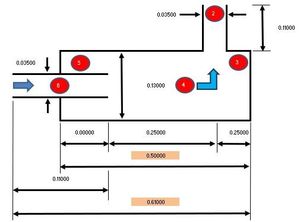
The displayed dimensions are the result of the entered data, allowing for verification of the input data's suitability (with the software, other sketches are available showing added lengths and total lengths - including added lengths - that are taken into account).
|
Figure 4 Summary of dimensions entered for modeling the reactive silencer with a single expansion chamber with side outlet using SILDIS software |
Remarks regarding the performance of a reactive silencer (muffler) with a simple expansion chamber with a side outlet simulated with Module 1B of software SILDIS
The input and output data (simulation results) above are those of the version of Module 1B of the SILDIS software normally sold; some cells (e.g. model selections for different calculation steps) are pre-filled by default with robust selections (which can be modified by the user) for the considered silencer mounting. In order to limit questions from possibly inexperienced users in relation to the input data to be considered (explanations being provided in user's manual foreseen to be completed by a training), it is possible to restrict the functionalities of the software package by fixing (instead of allowing them to vary) some input data/some models for different steps of the calculations (depending on applications), so as to further simplify the use.
The Module 1B of software SILDIS allows reactive silencer with a simple expansion chamber with a side outlet simuled performance results:
- not necessarily using english language: french is possible too (also for entering input data)
- possibly comparable with some laboratory measurement standards e.g. NF EN ISO 7235 Acoustics - Laboratory measurement procedures for ducted silencers and air terminal units- Insertion loss, flow noise and total pressure loss (when appropriate models are selected in software drop-down menus)
- which can be obtained in less than a quarter of an hour, including time necessary for data entry (cf. tutorial[0])
Acoustic performance - without the consideration of self-noise - is determined using the transfer matrix method to model sound transmission with fluid flow through a cascade of basic silencer elements, the arrangement of which (i.e. their specific sequence) is pre-programmed for various configurations (depending on element to be considered for the modeling, to which corresponds a matrix relevant for its group[1], for which the - geometric - characteristic length is adjusted by a length correction[2] that accounts for the specific geometry. Consequently, the modeling approach is not limited to the case of the simple expansion chamber as considered in this example.
The Module 1B of the SILDIS software also enables the prediction of silencer performance for more complex case studies - such as those encountered in certain industrial applications - involving modeling based on various configurations (more or less usual)[3] for which the necessary calculations are fully programmed:
- involving up to 3 expansion chambers in series:
- possibly purely reactive, as in the example featured in this publication (possibly accounting for gas flow direction reversal(s), e.g. using overlapping connecting tubes)
- possibly including a dissipative chamber[4]
- possibly including 1 or 2 Helmholtz resonators (with short or long neck)
- possibly including 1 or 2 concentric resonators - with perforated tube(s) -
- possibly featuring a radial silencer inlet
- possibly featuring a radial silencer outlet
With Module 1B of the SILDIS software, acoustic performance excluding self-noise (this later being calculated separetely with the same software module) can be evaluated using various indicators:
- sound transmission loss (TL) (as in this example)
- insertion loss (involving source and load impedances)
- sound pressure level difference at specified locations (sometimes referred to as "noise reduction")
These acoustical performance indicators are evaluated using an analytical method, whereas the evaluation of other reactive silencers (mufflers) performance indicators is based on regressions.
Overview of the methodology used for the evaluation of acoustic & aerodynamic performance indicators of reactive silencers (muffler) with Module 1B of software SILDIS
| Performance indicator | Performance without flow noise ΔL' | Flow noise Lw | Total pressure loss Δpt |
| Methodology | Analytic | Regression based on measurements | Regression based on measurements |
Returning to reactive silencers (muffler) with expansion chamber(s) with a side outlet, as modeled in this calculation example, there are numerous applications in the power generation sector (compressors, internal combustion engines for propulsion or electricity generation, i.e. generator sets) and for test benches:
- regarding workers protection (employees and external contractors handling supervision and maintenance, as well as engineers and technicians conducting laboratory tests who must be protected from hearing damage)
- regarding environmental protection (ensuring peace and quiet for neighbors of facilities housing engines, pumps, other turbomachinery, or other process equipment)
Thus, Module 1B of the SILDIS software enables the calculation of the aerodynamic and acoustic performance of reactive silencers - including self-generated noise (due to flow) - using a single Excel workbook[4] and a single data entry step, while employing different models depending on the element group[1].
The acoustic performance of an expansion chamber with a side outlet (EC1SO) differs from that of a standard simple expansion chamber (EC1) where the inlet and outlet pipes are aligned, all other things being equal. Figure 5 below presents the following results:
- for the configuration "without" a side outlet (i.e. the EC1 mounting):
- the sound transmission loss curve exhibits dramatic dips near frequencies that are multiples of c/2L = 343 Hz (where c is the speed of sound under the silencer's operating conditions in m/s, and L is the length of the expansion chamber in m); such performance weaknesses are, of course, problematic for the overall effectiveness of this type of noise-control device in practice
- the transmission loss reaches a maximum of 16.8 dB, a value that can also be calculated directly using the formula TLmax = 10 * LOG10 [ 1 + 0.25 * (m - 1/m)² ], where m is the ratio of the respective cross-sections of the chamber and the inlet/outlet tube
- for the configuration "with" a side outlet (i.e. the EC1SO mounting):
- such dips no longer appear near frequencies that are multiples of c/2L = 343 Hz, and the sound transmission loss is significantly higher than that of the configuration without a side outlet (the first dip in the noise attenuation curve appears at a frequency of 2c/L = 695.5 Hz—i.e. below the frequency f1,0 = 1545 Hz); a reactive silencer designed in this way offers superior performance and is therefore of greater practical value
|
Figure 5 Comparative acoustic performance of a reactive silencer with a simple expansion chamber with a side outlet using SILDIS software: sound transmission loss "with" and "without" tuning via extended tubes |
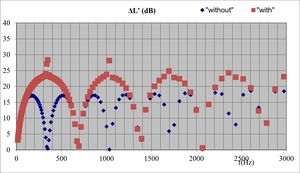
For the EC1SO mounting, the phenomenon responsible for the disappearance in the "with" side-outlet configuration of 1/2 the dips observed in the frequency response curve of the resulting acoustic filter is the resonance of the cavity with a rigid, impermeable base located at the expansion chamber outlet; this produces performance peaks at frequencies that would otherwise correspond to dips (throughs).
And this is not the only comparison of results that can be made in this instance, as the software offers the option to optimize acoustic performance through tuning i.e. by suggesting lengths (for certain assembly elements) that the user can input to enhance silencer efficiency, as illustrated in Figure 6:
- for the configuration "without" tuning:
- the sound transmission loss curve shows dramatic dips near frequencies that are multiples of 695 Hz; such performance weaknesses can be problematic when attempting to reduce noise emissions from certain noise sources
- for the configuration "with" tuning:
- such dips no longer appear near frequencies that are multiples of 695 Hz, and transmission loss reaches its peak in this frequency range - a peak that exceeds the maximum achieved by the "without tuning" configuration -
- dips appear only near frequencies that are multiples of 1391 Hz (i.e. above the frequency f1,0 = 1072 Hz); a reactive silencer sized in this way - following the tuning rules programmed into the SILDIS software - offers highly practical performance, as it covers several adjacent octave bands
|
Figure 6 Comparative acoustic performance of a reactive silencer with a simple expansion chamber with side outlet using SILDIS software: sound transmission loss "with" or "without" tuning |
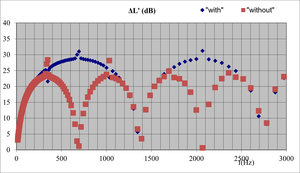
The phenomenon responsible for the disappearance - in the "with" tuning configuration (EC1SO mounting) - of 1/2 dips observed in the frequency response curve of the resulting acoustic filter is, once again, the resonance of the cavity (featuring a rigid, impermeable end) at the expansion chamber outlet, yielding performance peaks at frequencies that would otherwise correspond to dips.
In fact, the combination of such features makes the SILDIS software package - at the very least - a rarity, especially when the simulation capabilities it offers are accompanied by numerous other strengths:
- Module 1B of the SILDIS software eliminates the often tedious (complex, delicate, time-consuming, and costly) tasks associated with other calculation methods, thus offering several advantages (related to the fact that its use consists exclusively of filling in Excel spreadsheet cells with numerical values and/or selecting models from drop-down menus):
- no specific prerequisites for the user
- no need for extensive training, as getting started is easy after a very quick initial support session
- no need to import or create the silencer geometry, as it is simply configured by selecting dimensions
- no need for meshing
- the calculation time is not counted in hours, or even minutes
- the basic investment is limited to a single (multi-user) license with initial onboarding support for getting started (advanced support is available as an option), at no additional cost for subsequent years
- the license cost is such that even occasional use is sufficient to recoup, all the more so when it comes to a software package providing - notably for parametric studies - silencer performance evaluations that would be more expensive to obtain otherwise (assuming they are then as complete and reliable ?)
The Module 1B of software SILDIS (based on Excel) is the outcome of decades of development and validation (in conditions meeting requirement of ISO 9001 relating to quality management systems) in the domain of acoustics (with a specialization in sound propagation and transmission in ducts and multilayer structures) and aeraulics by a human ressource able to combine theoretical considerations with field technical feedback (laboratories, measurements sites). It is a polyvalent, user friendly and reliable tool for sizing reactive silencer (possibly with the integration of a dissipative stage[4]) in all contexts: from easiests cases (ventilation/air handling systems with ambiant thermodynamic conditions) up to most demanding applications in industry e.g. in energy production sector or for test benches (customizations are possible for a tailor-made tool, even for non specialized users).
Programming, marketing, training & hotline are available from one company: Isolation Technologie Services aka ITS. Being available with a near-perpetual licence (100 years), Module 1 of software SILDIS is a must-have for anyone involved in acoustical insulation/noise control, for engineering studies as well as for Research & Development (e.g. silencer manufacturers or integrators, engineering companies, acoustic consultants & architects offices).
[1] Uniform Tubes (UT), Extended Tubes (ET), Side Tubes (ST), Transverse Tubes (TT), Variable Tubes (VT), dissipative section (DIS), Helmholtz resonators (HR), Perforated Tubes (PT) for concentric resonators
[2] Termination Open Unflanged (TOU), Termination Open Flanged (TOF), Termination Connected-Coaxial, Termination Connected-Staggered (TCS), Termination Connected with Branch (TCB)
[3] Reactive silencers mountings for which computation is possible with software SILDIS: cf. link
[4] accounting for a dissipative stage requires a preliminary calculation using Module 1 of the SILDIS software, with some output data (the real and imaginary parts of the complex wavenumber in the airway) serving as input data for Module 1B.