ITS will participate in the design and construction of an anechoic room for acoustics R&D works near Paris (Île-de-France region, France). The project will provide technicians and engineers with a space enabling high-precision measurements of sound pressure and possibly sound intensity levels inside and outside automobiles to improve acoustic comfort for drivers and passengers during their journeys. With regard to electric vehicles, the aim is obviously not to address the noise emissions of internal combustion engines, but rather to characterize, reduce, and optimize (with respect to sound design criteria) the noise associated with:
- the movement of hoods, doors, and tailgates
- the operation of motors (windshield wipers, window regulators), fan motors (in the air conditioning system), and other accessories, e.g. pedals and switchgears, i.e. units that group together various controls of a motor vehicle: horn, turn signals, windshield wipers, high beams, low beams, and parking lights
Thus, the objectives of this project can be listed as follows (within a wide frequency range covering the 1/3 octave frequency bands centered on 100 Hz to 10 kHz):
- obtaining acoustic propagation conditions close to those of a free acoustic field (i.e. as outdoors in the absence of obstacles that room partitions are)
- obtaining a very low background noise level, below - overall - 20 dB(A) (to limit noise pollution due to adjacent spaces)
The first functionality of the anechoic room (whose design and construction is the subject of this article) mentioned above (the anechoicity of the testing room) will be made possible by the implementation of a broadband compact absorber, as illustrated in the picture below.
|
Broadband Compact Absorber for semi anechoic room for acoustics R&D works |
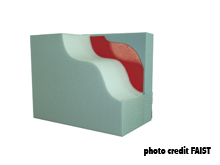
It is a multi-layer acoustic structure with (from back to front):
- a dissipative material (mineral wool, polyester wool or foam). Backed by the support that constitutes the envelope of the anechoic room, it has the vibroacoustic behavior of a spring
- a metal plate: combined with the layer located at the back, it constitutes a resonator, allowing acoustic absorption for low frequencies (in red on the picture)
- a dissipative material (mineral wool, polyester wool or foam): allowing acoustic absorption for medium and high frequencies
Thus, this absorber is:
- broadband, since it allows for free-field conditions to be achieved from a frequency as low as 100 Hz or even lower (this depends on the dimensions of the anechoic room and the volume in which anechoicity is desired: it is very large in case of testing for which subject can be a SUV - Sport Utility Veghicle -) and up to the highest frequency (10 kHz in 1/3 octave band), for which a technical requirement is specified in ISO 3745 Acoustics - Determination of sound power levels and sound energy levels emitted by noise sources from sound pressure - Laboratory methods for anechoic and semi-anechoic rooms
- compact, since it has a total thickness of 0.25 or 0.35 m for standard applications; it therefore stands out favorably from conventional wedges, the dimensioning of which, based - as far as its length is concerned - on a quarter of the wavelength corresponding to the cut-off frequency (mentioned above) would be, for an equivalent performance (an acoustic absorption coefficient of 99% absorption at normal incidence) of 0.85 m considering 340 m/s for the speed of sound in air at ambient conditions
As this is a semi-anechoic room, the sound-absorbing lining will be installed on the 4 vertical walls and at the level of the under-roof of the room, the floor (on which the vehicle will circulate during tests) reflecting the sounds (like an ordinary road); the sound absorption coefficient of the floor will be less than 6%.
The second functionality of the anechoic room (whose design and construction is the subject of this article) mentioned above (noise insulation of the testing room, with limitation of sound transmission through the partitions of the room) will result from the implementation of a high acoustic performance envelope (which will serve as a support for the internal sound-absorbing lining):
- with a floor (detached from the ground of the installation site - by means of an anti-vibration suspension with a cut-off frequency lower than 15 Hz - to prevent sound transmission by structure-borne vibration); as it is a semi-anechoic room, floor sound absorption coefficient will be below 6 %
- with four walls (including a door allowing vehicle access and a door for pedestrians)
- with a roof
According to the "box within a box" principle, it will be carried out using modular industrial soundproofing panels without sound absorbing face, in steel (with a sound reduction index close to 50 dB at high frequencies), and will include an acoustic doorset (pivoting) which will allow access for pedestrians and vehicle under test; cable passage (for acoustic metrology, and for the power supply of power outlets) will involve a special noise attenuator and air renewal will be made using ventilation silencers; the lighting which will be part of the scope of supply will be selected and integrated so as not to degrade the acoustic performance.
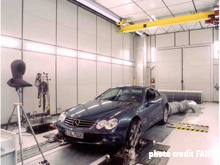 semi-anechoic room for R&D works in automotive industry (with car under test) |
The proper consideration of site constraints (which limit available space) and the integration of the two aforementioned functionalities (anechoicity and noise insulation) is a key success factor for such a design and construction project for a semi-anechoic room combining a sound-absorbing lining and a soundproofing enclosure with high-end anti-vibration decoupling.
The automotive sector is by far the one for which ITS and its business partners have the most numerous and most prestigious references when it comes to the implementation of broadband compact absobers with an outer shell to limit sound transmission, since our multidisciplinary expertise and our unique technological offering underlying such projects are particularly appropriate for this context, as customer expectations in this field are particularly well known and consistently met.
Performance, quality, time cycle, pricing: there is no doubt that the process, including a comprehensive study, a rigorous factory prefabrication of all subassemblies, and their careful on-site assembly, will result in the provision of a semi-anechoic room for acoustics R&D works of the highest standard, regardless of the angle considered.