An anechoic room, also called a dead chamber, is a space in which it is desired to reproduce, inside an envelope, the propagation conditions of the sound in a free field i.e. by freeing itself from the reflections of sound waves on the partitions, like for the situation observable outdoor.
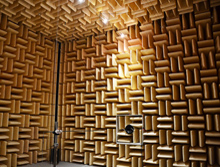
Anechoic room (dead room) |
Generalities relating to anechoic rooms (dead rooms) marketed by ITS
ITS offers acoustic test facilities and test benches: anechoic room , dead rooms (engineering, construction).
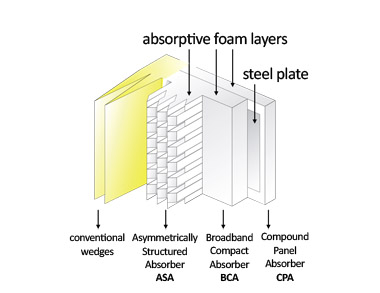
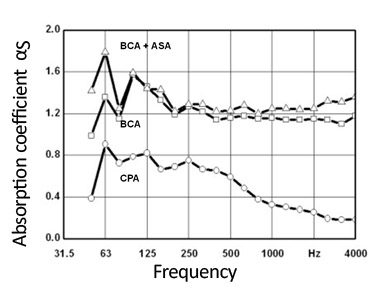
Depending on the needs, it may be either a semi-anechoic chamber (the floor is reflective) or an anechoic chamber (the floor is also absorbent), the anechoic behavior being made possible by the implementation of materials with the highest possible absorption coefficient (i.e. as close as possible to 100%) in the frequency range of interest, whose low limit is often referred to as the cutoff frequency (and is expressed in Hz). When it does not consist of dihedrons of absorbent materials (wedges), the lining of such an acoustic measurement room can be flat, if the technology of compact broadband absorbers is used (being based on a multilayered acoustic structure, with a rear resonator for the absorption of the low frequencies and with a front dissipative material for the absorption of the medium and high frequencies, leading to a lower thickness, which is significant when it comes to improving the performance (e.g. by decreasing the cutoff frequency) of an existing room whose boundaries must be kept).
In particular, the determination of the sound power levels (expressed in dB ref.1 pW) emitted by the noise sources from the acoustic pressure (whose levels are expressed in dB ref. 20 μPa) is possible in an anechoic room or in a semi-anechoic room (by laboratory methods), with respect to electro-acoustic equipment and devices, machinery or other sources of noise, provided that their dimensions are compatible with the measurement area given the dimensions of the testing space (which can sometimes accommodate vehicles).
Such measurements are subject to specific international standardization, namely through the ISO 3745 standard, which is often used by acousticians for their research and development in acoustics, which can also intervene in the field of psychoacoustics. In addition to the particular characteristics of anechoic behavior, a dead chamber often has performance in terms of sound insulation, if it comes to characterize the noise emissions of equipment for which a low background noise level is required or to limit the transmission of noise emitted by tested hardware from measurement rooms interior towards contiguous premises. If it is appropriate to consider the eventual dismantling of the testing equipment in case of a future possible relocation, an envelope made of modular metallic acoustic insulation panels may be an appropriate construction system.
This is why an anechoic room (dead chamber) must be the subject of an in-depth study (i.e. engineering work).
Specifics relating to the engineering and construction of anechoic rooms (dead chambers) marketed by ITS
The engineering work for anechoic chambers (soundproof rooms) marketed by ITS aims to provide testing facilities that justify contextualized acoustic characteristics:
- with a cutoff frequency (i.e. the lower frequency limit above which a volume, defined in particular depending on the size of the sound source which is tested, has the characteristics of a free acoustic field) sufficiently low, and with the possibility of carrying out measurements also at high frequency (possibly, in some cases: up to 20kHz)
- with a sufficiently low background noise level, in the case where it is a question of characterizing noise sources with low acoustic power, which sometimes imposes a very significant sound reduction for the envelope of the room, a fortiori when the construction is envisaged in a noisy environment (this is not uncommon in industrial sector) which may make it necessary to install double-shell walls (walls, roof), a floor with mechanical decoupling (to limit the transmission of vibrations) and doors with a special design, which must additionally be equipped with a sound-absorbing lining
- taking into account the needs for equipment, the presence of which must degrade neither the anechoicity nor the airborne noise insulation of the room: lighting, ventilation - not only for the renewal of sanitary air, but also, sometimes, for the evacuation of the calorific power of the equipment under test (e.g. when it comes to engines, for which the evacuation of exhaust gases must then be designed taking into account the need for silencers), handling equipment, devices for converting the room (the property of anechoicity or semi-anechoicity can be modified according to the installation or dismantling, as necessary, of mobile sub-assemblies absorbing sounds or reflecting them)
- considering the dimensional constraints (when made with conventional sound absorbing wedges, an anechoic room with a cut-off frequency of the order of 100 Hz, which is common, and with a double shell for the envelope can have walls whose thickness is around 1.50 m, while the use of compact broadband absorbers - of equivalent performance - approximately halves this space requirement)
The tasks related to the design of anechoic room (dead rooms) marketed by ITS include:
- choosing the dimensions of the acoustic measurement room, its placement within the allocated space, and defining the interfaces (access for users and equipment under test, openings for ventilation, for cable routing – for power supply and instrumentation –)
- predictive calculations (including modeling involving specialized software such as SILDIS [1] for some computation steps)
- for defining a volume in which anechoic conditions are met across the entire frequency range of interest (in this respect, the properties of the sound-absorbing lining are crucial), taking into account regulatory constraints in terms of spatial sound decay
- for evaluating airborne sound insulation (in this respect, the acoustic attenuation of the composite partitions, including the enclosure enveloppe, doors, openings for ventilation, and those related to the electrical and fluid networks ancillaries is fundamental - the choice of ultra-high-performance materials and construction systems is crucial for sound attenuation in such contexts -) and for limiting the transmission of structure-borne sound (the usual objective of a sufficiently low sound pressure level inside the room - the background noise level - can in some cases be supplemented by another - not to be overlooked - relating to a sufficently low noise level outside the room when noisy test equipment must not cause a nuisance to the environment)
In such cases (as for more common air compressors), it will be necessary to enclose the boosters/expanders in a metal structure with a frame and with:
- for fixed or easily removable parts, by elements: acoustic panels (modular)
- for acces: (rotating) acoustic doorsets with, for translucent parts (with glazing guaranteeing residual safety in the event of accidental breakage): acoustic window sets
- for room partitions inner sides: highly sound absorbing linings e.g. FAIST range
|
|
|
. |
The very high degree of industrialization of these elements allows for smooth construction projects, with controlled deadlines and costs, and without unpleasant surprises regarding the quality of the finished products, which are made to last. The construction of an anechoic room is a specialist business, the know-how involved for all the stages of such realization conditioning the acoustic performance on site:
- installation of envelope elements (walls - including doors and hatches of all kinds -, roof, floor - in some cases: on anti-vibration pads -)
- fitting of the sound absorbing lining
- works relating to details such as passages of cables, pipes, supports for different uses and implementation of various equipment (not only finishing works)
- silencers implementation
Experience counts in this field: ITS (whose human resource is familiar with all aspects of such projects in terms of engineering and realization) can participate in the design and construction of your acoustic test facilities and your test benches, for successful projects in all contexts.
Spread the word !
[1] SILDIS® = Sound Impact Limitation: Design for Industrialized Solutions